
Update- Some changes over the last few hours
Update2- Anthony Watts has contacted Lindzen for clarification
Update 3 on bottomScience is an evolving process. Data, models, and methods all evolve in time, correcting errors along the way, and building more questions or robust conclusions in the process. It is necessary for people with expertise in a particular area to keep up with the data and any changes that may be made to it, as well as the underlying problems that may exist within the data. In some unfortunate cases, people lose objectivity and will use only a particular dataset (or version of that dataset) that re-inforced some point they are trying to make. In presenting information, not telling people outside of their field what the possible caveats are in a dataset, or explaining revisions that were made to data they show is not generally taken well in academic setting. So it is with a recent example.
Richard Lindzen has made his presence felt at Anthony Watts blog in “Lindzen on Negative Climate Feedback”. Accuweather also has a recent blog post on it. In the comments, it is being hailed as the new found gospel truth of negative climate feedbacks and low sensitivity. Unfortunately, the problem with most skeptical arguments is not what we are told, but rather what we are not told. So what aren’t we told?
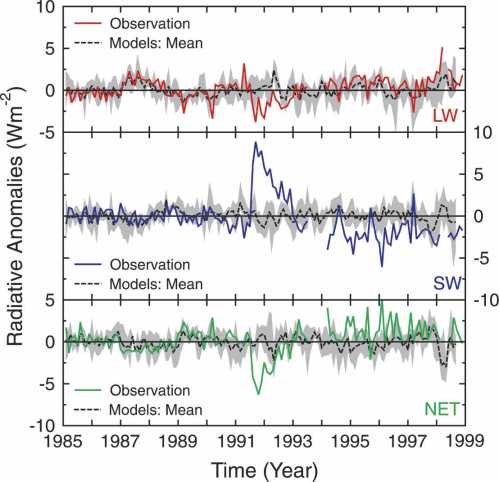
Lindzen’s method is easy to understand. You can read it at Watts’ blog. The image of emphasis is,
Lindzen’s emphasis is on the outgoing LW flux at the top-of-the-atmosphere, and the fact it is large compared to models. This is inferred to mean less of a “blanketing” effect from greenhouse gases, and therefore feedbacks which are less positive than models suggest (or negative in this case). At “RealClimate”, gavin pointed out a fixed graph that appeared in Science after a comment by Kevin Trenberth. The changed figure is,
However, there have been major revisions to this data since 2002. Specifically, there was a significant correction for changing satellite altitude in the computer code that was not turned on which led to erroneous results in the earlier work (Bruce Wielicki, personal correspondence). In many other cases, this kind of thing would be something WUWT would be on top of, so it is unfortunate that it is not mentioned. There is an inverse square dependence on the amount of energy received at the Nonscanner WFOV instrument and the distance from the planet’s center; improperly accounting for altitude change led to spurious results for the TOA longwave and shortwave fluxes. This has been documented in Wong et al 2006, Journal of Climate, a paper not even mentioned by Lindzen. ERBE S10N_WFOV ERBS Edition3 Data Quality Summary is available to cover further issues. They state
Algorithm Changes between New Edition3 and Previous Edition2 Release
The main difference between new Edition3 and previous Edition2 release is in the treatment of TOA radiative fluxes resulting from changes in the ERBE nonscanner processing algorithm to account for decay in satellite altitude over the data period.During an instrument performance study, Lee et al. (2003) discovered that the ERBE nonscanner inversion algorithm did not correctly account for the decay in the ERBS altitude over its mission lifetime; this can have a small but significant effect on the reported decadal changes of nonscanner TOA fluxes. The ERBE nonscanner inversion algorithm is used to convert nonscanner measurements at satellite altitude (approximately 611 km at the start of the mission) to TOA measurements at a reference altitude of 30 km. While these altitude changes over the 15-year period are small (on the order of 25 km) and do not affect the overall quality of the large regional fluxes, they do, however, have significant effect on the smaller changes associated with the observed large scale decadal changes in Earth radiation budget (Wong et al., 2005).
This satellite altitude related problem is unique to the ERBS nonscanner instrument and does not affect the quality of the ERBS scanner data product. The nonscanner is a hemispheric instrument which views the entire Earth disk along with the small portion of the deep space surrounding the Earth itself. As the satellite altitude dropped over its mission, the small portion of the deep space partially viewed by the nonscanner began to be filled in by the Earth view itself, resulting in more energy being recorded by the nonscanner instrument. Since the original and the Edition2 release data did not account for these subtle altitude changes, there is a small effect of artificially increasing the reported longwave, shortwave, and net fluxes over the mission lifetime. Specifically, the overall effect of this altitude change is a small increase (~0.6%) in both longwave and shortwave radiation over the 15-year period.
To minimize errors in the ERBS nonscanner data product, an altitude correction algorithm to the Edition2 data was developed and applied to the entire Edition2 data set. The result is the new Edition3 data set.
Actual ERBS Edition 3 data is available at Nasa langley. I will leave readers to explore further details. Assuming he was familiar with these updates, Lindzen should have at least told his readers why he felt the older version was better for his analysis. The experts working on it apparently do not think so. An examination reveals that these corrections eliminate most of the signal that Richard Lindzen was using (see figure 5).
Section 5 of the 2006 paper also does comparison with ocean heat storage data, where the two agree within the uncertainty of the ocean data sampling. This is pretty neat given the independent nature of the ERB data and ocean heat content measurements, an example of robustness that distinguishes results appearing in peer-reviewed documents vs. those in blog protocol.
In short, Lindzen’s analysis is based on outdated data that has been revised since 2002, and these revisions are not exactly recent, so he should have been aware of them. Using the more recent data would not allow him to make his argument as presented as WUWT. It would be nice to see an update at WUWT reflecting these changes.
I’ve said quite a bit about feedbacks lately and it’s a little old now, but many WUWT commenters still seem confused about how postive feedbacks relate to an unstable system. Lindzen has recently been using the “gas pedal” analogy (not only in Watts’ post, but at the skeptic conference) in which positive feedbacks are supposed to be analogous to someone changing the gas and brake pads in your car. If you want to slow down, you actually speed up. Apparently it follows that climate does not act this way. Actually feedbacks don’t really act this way either. If we let the moving car roll on a flat, frictionless surface (with no influence from the tires or air resistance) in the absence of any net force change, it will roll forever by Newton’s laws. Think of this as some equilibrium condition, with the climate analog being radiative balance. Pushing your gas or brake is more like the “radiative forcing” on the car which essentially puts it off of its current course. Positive feedbacks simply let the planet equilibriate at a higher temperature than the sensitivity from CO2 alone, but the same principle that balance is acheived still applies. Feedbacks go up like a converging power series and therefore never get strong enough to override the fourth power dependence of thermal radiation and trigger a “runaway.” In short, positive feedbacks can be stable and don’t require any runaway scenarios.
Update 3– Lindzen has responded to Anthony Watts at his blog post. I wish that more was to address, but to me he didn’t really say anything meaningful, but that is for readers to make judgments on. Essentially Lindzen has set up the usual attacks that adjustments are always made to favor “alarmism” (which is incorrect, if he bothers to read the standard literature from HadCRUT, GISS, etc on their methods; perhaps if his claim was more specific, he knows it would be that much easier to invalidate). A reduction in the LW flux at the TOA can be interpreted in other ways as well, some might argue for less overall warming in the 20th century for instance.
Lindzen once again claims that the changes still imply negative feedbacks, which is a rather dubious claim, given the discussion and comparisons with models in Wong et al. I also do not believe the full range of sensitivity can be evaluated from these results, but even so, the justification for strong negative feedbacks has vanished.


-
Recent Posts
Archives
- June 2012
- August 2011
- November 2010
- August 2010
- July 2010
- May 2010
- March 2010
- February 2010
- December 2009
- October 2009
- September 2009
- August 2009
- July 2009
- June 2009
- May 2009
- April 2009
- March 2009
- February 2009
- January 2009
- December 2008
- November 2008
- October 2008
- September 2008
- August 2008
- July 2008
- June 2008
- May 2008
- April 2008
- March 2008
- February 2008
- January 2008
- December 2007
Recent Comments
John Baez on Retirement Bob Armstrong on Retirement Martin Lewitt on Judith Curry on ‘dogma… Ross on Physics of the Greenhouse Effe… John Brookes on Judith Curry on ‘dogma… Categories
Blogroll
- Arthur Smith
- Atmoz
- Climate Change
- ClimateSight
- Cronen: Physics is Phun
- Dot Earth
- Fermi Paradox
- Global Warming Art
- Global Warming Student Guide
- Gritsmill: GW Skeptic’s guide
- Grumbine Science
- History/Discovery of Global Warming
- Intergovernmental Panel on Climate Change
- James’ Empty Blog
- Judith Curry
- Logical Science
- Michael Tobis
- NERC UK
- Pew Climate
- Rabett Run
- RealClimate
- Roger Pielke Jr.
- Roger Pielke Sr. Research Group News
- Stoat
- Tamino’s blog
Pages
Meta


 Climate Change

“positive feedbacks can be stable and don’t require any runaway scenarios”
If that’s the case, why do we hear so much from the likes of James Hansen and James Lovelock about tipping points and time running out?
Response– “Tipping Points” and “runaway” are different in scientific meaning. In both cases, the public and blogs often use them in sloppy ways, but the impossbility of a “runaway” (which I mean to use in the Venusian sense) do not exclude “tipping points” (loss of seasonal artic ice, permafrost release of carbon/methane, large scale Amazon loss, THC weakening, etc)– chris
I don’t think Lindzen said what’s in that last sentence. In fact, there are little pieces from Lindzen’s statement all mixed together to score some kind of point, I guess.
To get back on point, Lindzen was providing a simple [and effective] analogy of positive feedbacks. Besides, with CO2 rising steadily, at the same time the planet cools steadily, the AGW/CO2 hypothesis has taken about 4 – 5 torpedoes. That ship is going down.
With the AGW/CO2 hypothesis sinking fast, the entire AGW/global warming argument is falsified by the planet itself. Except, of course, in the minds of those wackos who still believe that black is white, down is up, evil is good — and global cooling causes global warming.
In that case, they have my sympathy; cognitive dissonance that extreme is generally incurable.
[Oh, and congrats on the multiple responses! You can thank WUWT for doubling your hits.]
Response– Well you can keep being wrong and actually look at the data, or you can take somebody’s word for it. “The planet” has only been verifying the mainstream view of scientists, and the mainstream view has evolved based on the actual data. The planet is not cooling, the ice is still melting, and sea levels are still rising– or are you in denial of all of this? Maybe you should review the primary literature and actual data to see how silly you sound– chris
Even with the corrected data there is still more outgoing LW than the models show.
Response– It is within the range, except for 1998 and variations associated with Pinatubo. Please read the cited paper. There is no longer evidence for a neutral or negative feedback, and in fact the authors explicitly state they find no evidence for IRIS– chris
WUWT has succeeded in brainwashing a lot of people, it’s kind of sad. I’ve never seen a single site host more confused comments and erroneous analyses.
Response– I usually agree. It’s also very reliant on the views of outliers in the field, in the cases where he has qualified people post. Being an outlier doesn’t necessarily make one wrong, but few people over there even know what the science of AGW says, and so if you’re just learning from deviant views without understanding what the literature says, you’re probably going to be misled. Putting much weight on one person in the face of 99 others is not a good idea.
Have you had a chance to look at the references Lindzen said backed up the original data? Presumably they don’t now back up the corrected version, or have they all been corrected too?
Response– I’m familiar with just the first study. I don’t see how their results are dependent at all on this change. Really, it was not even a major point in the paper. It may come as a surprise to some, but actual studies do more than make a couple of pretty graphs with no kind of analysis, no discussion of observation or model uncertanties, no physics, etc and then fall apart when someone finds an error. See the RC post under “robustness.” I’m also aware of some of the authors (like Tony Del Genio and Brian Soden) and their work and views on climate change. I know Wielicki was not amused when I e-mailed him, and had some harsh comments about what Lindzen and the skeptical movement as a whole has done.
That ocean heat content data which is now apparently comparable – within the uncertainties – is the same data that was also corrected for apparent cooling errors isn’t it? I’ve not heard yet of a data correction made due to an instrument showing too much warming, ie does it make sense that the corrections always seem to go only one way – towards the prevailing theory.
Response– Huh?!?! There are warm and cold biases in data that need to be adjusted for. Both exist. Correcting for problems is not an elaborate conspiracy by all of these groups. Judging by your tone, you’re only making yourself aware of those “corrections” which apparently “show more warming.” Did it ever occur to you that the prevailing theory is what it is because of what data shows? I can’t believe what I hear.
I’d need to read that calibration study you mention but I’ve a funny feeling the corrected algorithm was defined with respect to a model output because that’s how the radiosonde corrections were made. After all, if you knew what the answer should be then you wouldn’t need the instrument measurements in the first place would you?
Response– This is not WUWT. I expect seriousness
It’s all sort of “cart before the horse”. In that light, can these corrections truly be objective? I’ll be interested in Lindzens response to the charges mind you.
Response– I’m sure the folks at ERBE are doing what they can to make the data as best as possible. Fitting it to “the theory” is not what people spend their time doing. You’re spending way too much time listening to deviant views on the subject.
Further Response– I just had a chance to look at this slide sequence from Clement and Soden
Click to access clement.pdf
In the first few slides they are clear to discuss altitude issues from Wong. Is Lindzen being serious?– chris
This blog’s great!! Thanks :).
Why is it Chris, that every time there is a contradictory piece of evidence (empirical evidence that is), someone comes along and (trys to) re-write all the empirical data so that it comes closer to the theory.
I’m assuming these were very carefully designed experiments to start with since they were so important. Billions of dollars would have been spent.
The other examples:
– Temps are not keeping up with the model’s predictions.
Answer: rewrite the historical temperature record and add 0.5C to the trend.
Answer: rewrite the Aerosols data so that there is a -0.3C to -0.5C impact from Aerosols.
– Humidity is not keeping up with the predictions.
Answer: discredit the data so that there is no actual humidity data anywhere that can be relied on despite humidity being measured by half the weather stations across the planet over the last 100 years.
– PaleoClimate reconstructions do not support the +3.0C per doubling estimate.
Answer: rewrite the historical CO2 numbers so that they come closer to conforming.
– There are dozens and dozens of climate and meteorological satellites up there right now and not one is showing the data that the theory expects.
Answer: orbital drift … sensor problems … bury the data
Answer: none of the satellites are providing the basic data we really need – Hansen every few months – why are we spending Billions of dollars for the wrong data.
– The models consistently over-estimate the temperature trends by a factor of two.
Answer: re-write the previous predictions each time a new set is produced.
Answer: never produce climate predictions that can be checked on any timescale (Hansen twice made this mistake now so I’m assuming he won’t do it again – the IPCC certainly understands this).
This pattern is getting harder and harder to ignore, don’t you think.
Now that is just my little strawman regarding how to shoot-down your analysis. It is not fair because perhaps your points are valid.
What I want to see for the pro-AGW crowd is to at least look at the contradictory evidence for once instead of:
– ignoring it;
– discrediting it through strawmen; or
– rewriting it whenever it doesn’t conform.
Response– Well half of this you are just making up. Most of these “observations don’t fit theory” lines are based on a misunderstanding or misrepresentation of what observations,models, or theory actually show. For me, the “pattern that is hard to ignore” is that most of this comes from people who only read one or two blogs, (WUWT happening to be a top one). The nonsense comes mainly from “fake experts” and occasionally a handful of real experts who sit on the outlying edges of their subject, and is then amplified by cheerleaders who have no idea what people are talking about, but are convinced it’s a hoax. The claims are rarely in accordance with what experts say, or they don’t seem to want to “tell the whole story.” This is why skeptics have their own “climate conference” because they can’t get much through peer-review from experts in the field. It’s not conspiracy, it’s just very one-sided science. The sooner you realize the denier position is full of crap the better off you will be.– chris
Now please, this is a science blog. This doesn’t need a strawman and conspiracy component to it– chris
Wow. It’s very easy to just admit that Lindzen was either ill-informed or he tried to pull a fast one. If you admit it and move on, rather than sit here and complain and make excuses and twist it into “well the real experts changed the data to fit” than your lives will be much easier.
Bill,
ignoring it;
– discrediting it through strawmen; or
– rewriting it whenever it doesn’t conform.
You’ve summarized msot denial arguments. Stop playing.
Thanks for your summary above.
I wrote this on WUWT
Surely the climate is a metastable system as indicated by ice core records etc:
Super ice age (snow ball earth)(?)
Ice age -2degC
warm age 0degC
Hot age(?) +2degC 40Mybp +8degC 400Mybp
Positive feedback is not an unlimited effect GHGs have logarithmic effects enabling the negative FBs (plant growth, radiation balance etc) to re-take control.Methane trapped in frozen tundra may be released if the temperature increases. CH4 in the atmosphere has a life of about 4 years. So the tipping point when these are released may only produce a pulse of high temeratures for a couple of decades.
However this may be long enough to melt land based ice reducing the albedo and adding to the positive FB. However these effects are self limiting – plant growth, radiation balance (a hotter earth = more heat radiated but same heat input) will attain a new stable temperature.
The question is what will this be? and what will reduce the climate back to the current metastable state?
—————
The earth definately has 2 reasonably stable states iceage and non-iceage (the other states have only occurred in periods where land masses were differently located.
GHGs will have little effect as the absorption bands saturate (logarithmic saturation) This will limit the effect of this positive feedback (hotter earth = more CH4 from clathrates, less absoption of CO2 in sea = more GHGs = higher temps) The GHGs will also affect temperature negatively with positive feedback (lower GHGs leads to cooler temperature leads to more CO2 dissolved in sea leads to lower GHGs – note that this is still a positive feedback!)
Negative feed back on CO2 would be plant growth. Higher CO2 leads to more plants leads to less increase in CO2 (neg feedback lowering temp) AND lower CO2 leads to less plant growth leads to less lowering of CO2 (neg feedback raising temp)
Ice surface presented to the sun will affect albedo which will affect outgoing radiation which affects energy balance. Ice is a positive feedback thing – low temp leads to more iceleads to lower temp and vice versa. As the ice melts it retreats to the poles where solar radiation is smaller and so will have less effect on the energy balance. Howerver an increasing ice sheet will have a negative effect on temperature (again positive feedback more ice=lower temp=more ice). Why does the ice not continue to grow till snowball earth is reached? Does it simply stop growing where the temperature finds an equilibrium between the solar radiation melt and the albedo effect on temperature? Or is there some other effect?
The difference in temperature between too hot and too cold is only a surprising 2degC
just some thoughts which may clarify positive and negative feedback effects.
Mike
Response– Actually it’s more in the 5 C range between today and the last glacial period.
I still don’t understand why people think positive feedbacks mean that a runaway greenhouse (or a snowball earth) or some sort of “extreme” is necessary. All it means in the climate literature is that the sensitivity is greater than 0.30 C/W/m2. Lindzen got that number from taking the temperature change 1.1 C divided by the radiative forcing, 3.7 W/m2. There’s nothing magical about sensitivty being higher than this; successive terms in a power series become progressively smaller when the feedback term is less than one. It’s the weird same logic as asking why negative feedbacks don’t lead to a system where nothing ever changes. — chris
Accuweather has finally reached it’s bottom.Here is a quote from a Dr.Richard Lindzen:
“Isn’t this amazing, as the temperature goes up, negative feedback goes up. As the temperature goes down, the feedback starts going positive”.
Has anyone heard of this jerk. A feedback mechanism is an effect of a positive Forcing. It creates a feedback loop.Like as there is less Ice in the arctic,less reflectivity. More absorption,water warms. This guy has to be some kind of nut. I can’t believe that AccuWeather would post this bullshit.
The colder it gets the more water vapor there is.The warmer it gets the less water vapor there is.The sun cools,so the Earth is warm. The Earth Warms the sun, so the Sun cools the Earth.Makes perfect sense if your Anthony Watts or Dr.Richard,Exxon Mobil,Lindzen.
Response– To be fair, Lindzen is a very bright guy. However, he seems to be a scientist who cannot admit he is wrong, and will likely continue on defending deviant hypotheses. I don’t really know or care about any sources of funding he might have. He had an older idea concerning a strong negative feedback from water vapor, which observations and physics have invalidated over the last several decades. He had an IRIS hypothesis some years back in which the science community has seems to have moved on from.– chris
0.3C per W/m2 is what is built into the climate models right now, isn’t it?
Response– No. Feedbacks and sensitivity are not built into models, they are emergent properties. In any case, 0.3 is the no feedback (net neutral) sensitivity. The estimated sensitivity from mainstream estimates (e.g., documented in IPCC AR4) is 0.54 to 1.22 C/W/m2 which corresponds to 2 to 4.5 C per doubling. It’s an unfortuantely large uncertainty, but it’s positive– chris
Chris: In a recent Article you said that water vapor accounted for 7% of thhe Earths Warming . Or was that for all GHG’s. When you have a positive feedback, such as water vapor how do you determine it’s value. The Warming Arctic is a good example. The Arctic could be warming by natural and Anthropogenic Global Warming. If it is warming by AGW in the smallest way, there must always be a positive feedback component however small.As the AGW increases in time, the Ice will melt more and the feedback value will be higher.From warming a decrease in ice, means a decrease of reflectivity or a positive increase in absorbtion. Now for this positive feeedback loop to reach a tipping point, how could you make that measure.
You cannot assume a tipping point will occur.Wouldn’t you have to make many assumptions.Just because AGW is the signal, that doesn’t negate natural variations. Any thoughts?
So when do the models start building in “feedbacks and sensitivity”? Is it hundred of years into the future or just a few decades?
Sorry, trick question. I fully know what is built into the models and they have not built in any changing feedbacks or sensitivity whatsover.
It is LN (GHGs) all the way and the GHG formulae do not change over time at all.
It is 0.3C / W/m2 in 2100 just like it is in 2009.
Chris,
Thanks for this analysis.
You’ve said in response to James G. (I paraphrase) “of course the data isn’t always corrected in favour of the AGW theory.”
In a Lindzen 2009 paper (Climate science: Is it currently designed to answer questions?) available online: http://arxiv.org/ftp/arxiv/papers/0809/0809.3762.pdf
Well I believe Lindzen himself has made the same point (I believe referring to a slightly different context):
FYI the Pielke et al. paper he cites is here:
Click to access R-342.pdf
But this has had me thinking: the issue of data correction ought to be resolvable in a scientific way by simply counting through recent history the number of corrections to data that have occurred, and noting the direction of their change (i.e. in support for AGW or in contradiction of AGW). From the law of averages we’d expect that errors in the data would 50% of the time support more warming and 50% less warming. Lindzen seems to be claiming that they’re falling in favour of more warming significantly more than 50% of the time. If that was true, then you’d surely agree that he has a valid point.
At any rate, can you actually name some of the occasions where the data has been corrected significantly to show that there is less warming than the data first showed?
I’d also be curious to know of your thoughts on a paper that I haven’t actually been able to read myself yet as it’s not available online but it’s this one:
Rondanelli, R., and R.S. Lindzen (2008). “Observed variations in convective precipitation fraction and stratiform area with sea surface temperature”. J. Geophys. Res. 113. doi:10.1029/2008JD010064. http://www.agu.org/pubs/crossref/2008/2008JD010064.shtml.
From the abstract it appears to be discussing evidence for the Iris. It seems to have passed the peer-review at any rate.
Very enlightening, loads of thanks! 😀
chris, you said: “Now please, this is a science blog.” Please explain how that comports with the lines you wrote immediately preceding this assertion. Such as
“The sooner you realize the denier position is full of crap the better off you will be.”
That makes this blog more of a walled castle than a science blog. Broad brush insults are the technique of advocates, not scientists. Where is your curiosity? And where in any of your reply to Bill Illis is there an acknowlegment that confirmation bias is a natural human phenomenon even among conscientious scientists?
Besides there is no such thing as ‘a denier position’. In fact there are several. I’m sorry you must spend so much time swatting at flies. I’m sure it must feel like an inconvenience. However, that is how science is done.
Chris, Excellent summary. I gave up on Lindzen when he stopped caring whether what he said was true or not–e.g. when he alleged that there was a common cause of warming for several moons and planets in the solar system. He knows well enough that climate on the other planets is quite different from that on Earth.
You are entirely too patient with the half-wits from Watts-up-his-arse. The sooner we get these loons back into their asylum, the better. They add nothing to the discussion and are ineducable besides.
“Never try to teach a pig to sing. It doesn’t work and it annoys the pig.” –Mark Twain
This is a Science Blog?
Chris….. really. This is a propaganda blog.
Richard Lindzen is most certainly more credible than Chris sombody.
Bill is perfectly correct here, after the clearly fradulent garbage from the AGW cult over the last few years (Hansen, Mann etc) you guys have no credibility left at all.
The AGW Industry is simple in full panic mode.
I can see from the comments that no one can admit that Lindzen was just out-of-date or is trying to mislead. Instead, this has turned into the typical denial tactic of twisting it around on the “Pro AGW side” (whatever this means) and making it out to look like conspiracy or “fixing the data.” None of you seem to know how data adjustements work. In fact these ERSE updates are pretty old news in the radiative transfer community and Lindzen should have been made aware of them. His citation to Clement and Soden apparently would have made him aware of it, but he didn’t feel his readers deserved to see the Edition3 series.
Essentially you guys have made it clear that you’d rather leave in obvious errors which reduce the global warming trend. The fact is that Watts’ blog has no quality check whatsoever. He’ll put up any misleading or outdated nonsense that appears to add something to the “debate.” Apparently none of the angry commenters here are honest enough to read the primary literature and see this.
What SYl calls “curiosiy” is rapidly evolving into the next creationist movement or Flat Earth Society. I’m going to need to take Ray Ladbury’s advice in order to keep my sanity. Further comments on nonsense will be posted but ignored by me. The scientific community has long moved away from them, and I need to as well.
Typical response.
We are well aware that we are being lied to Chris.
That is why we object to your nonsense.
In fact, he recently put up the abstract from Lu’s most recent paper. Watts put it up claiming that “maybe cosmic rays, not CFCs” cause ozone depletion. Totally unaware that the paper proposes another mechanism by which CFCs cause ozone depletion.
Watts has a history of scoring own goals of that sort, and the crowd there managed to flood the thread with steady stream of “see! CFC ozone depletion is now proven to be a fraud!”
I wonder if Lu is aware of this gross misrepresentation of his work? If so, I imagine the wall of his office has a few dents from all the head-banging that results from such ignorance.
I would like to second the comment made above about auditing the direction of adjustments to the measurements over time. If a large majority of the corrections are in one direction as opposed to another, this would be pretty good evidence IMO that something besides the desire to present a valid picture of reality is driving the corrections.
IAC, it seems that for a wide variety of these sorts of issues the point is that the models predictions can’t be said to be falsified *yet*. It is not as though the models are doing well at all.
Cheers, 🙂
Very enlightening, Chris, thank you! 😉
You made the point there: who among this skeptical crew has made any comment about the article? Just one, I think. The rest is just off-topic and with such a label should be ignored. Besides, it really looks like a socio-moral punishment; negative reinforcement by electroshock therapy. Nasty. Please, don’t let them succeed and keep up with this good work 😉 Thanks again!
Aww Chris, it’s not that bad.
Alex Harvey above raised perfectly valid points yet your response is the classic we hear from the pro-AGW crowd every time they are remotely cornered: hurl invective and abuse at your critics. You get away with this because you have managed to scare the public into supporting your side of the story. That’s fine, but it’s not science.
Thanks Chris for the counter argument against Lindzen. I regard myself as a skeptic, and reads WUWT and CA regularly.
I guess most of the skeptics have an odd fealing that data with support for some counter argument against the CO2 hypothesis tend to bend to neutral after some time.
I do not agree with Ray above. You atleast got my ears and brain something to think about. Keep up the good work!
Bill Illis, you claim that, “I fully know what is built into the models and they have not built in any changing feedbacks or sensitivity whatsover.”
From this link you can browse the entire source code of the iteration of the National Center for Atmospheric Research’s “Community Climate System Model” which was used to submit runs included in the IPCC’s Fourth Assessment Report. Would you please identify where forcings and feedbacks are explicitly scripted in the code? I’m particularly interested in where the temperature is calculated straightaway as a logarithm of [CO2].
An excellent, thoughtful post Chris.
Thanks.
Science:
http://www.nature.com/nature/journal/v458/n7236/edsumm/e090319-07.html
“… over the past 5 million years, the West Antarctic ice sheet transitioned between full, intermediate, and collapsed states in just a few thousand years. This means that the ice sheet is likely to disintegrate if ocean temperatures in the area rise by 5 C.”
Even if you don’t have a subscription or go to the library to read the full article in Nature, you can get the supplemental info, including charts and videos, from Nature’s links on the several pages of related articles in this issue.
http://www.nature.com/nature/journal/v458/n7236/suppinfo/nature07867.html
http://www.nature.com/nature/journal/v458/n7236/fig_tab/nature07809_ft.html
The sediment core to which the model is compared comes from ANDRILL:
http://www.andrill.org/science/projects
Re: Auditing the direction of corrections
Gee, and here I thought data ought to be corrected in a way that makes it more correct. Gosh, you guys over at Watts up his arse sure have a revolutionary approach to science. Maybe you can help out the Answers in Genesis folks, too, huh?
Oh, add this — another from the several in Nature on Antarctica:
http://www.nature.com/nature/journal/v458/n7236/full/458295a.html
http://www.nature.com/nature/journal/v458/n7236/fig_tab/458295a_F1.html#figure-title
The evolution of a theory describing a complex physical system will necessarily involve a focus on resolving first larger and then progressively smaller inconsistencies, and unless there’s something fundamentally wrong with the theory the corrections will tend to bolster rather than undermine it. That this is so should be less than amazing.
Hi Chris,
I believe that my post above was serious, and is deserving of a more serious response.
Lindzen, as you have said yourself, is a very smart guy. He is probably the most expert scientist alive on the theory of atmospheric tides and planetary waves. He provided the explanation of the diurnal and semi-diurnal tides that we accept today as fact. He also provided the theory of the quasi-biennial oscillation that we today accept as fact. He points out rightly that today’s GCMs still can’t model the QBO; perhaps he has a better right than most to have an opinion on whether or not this failure is serious. He has provided one of the leading theories to explain the superrotation of Venus. He provided the convection parameterisation that is implemented in some of today’s GCMs (e.g. ECHAM3). He was the first to develop models for ozone photochemistry and its interaction with radiation in the stratosphere.
It is possible, as you say — and as others have suggested — that he just won’t admit that he’s wrong. Perhaps that’s because he’s been right so many times in the past. Or perhaps it’s because he’s not wrong. Have you actually read through his 200 or so papers? If not, I would thoroughly recommend that you do.
Response– Well he’s been wrong plenty of times too. As I understand, the theory of Venusian super-rotation is not completely gone, but is not the leading theory. I don’t have the background to comment though. He’s been wrong about water vapor and IRIS feedbacks. He’s been wrong about many things below the stratosphere, especially in the realm of climate feedbacks. His expertise has been more in dynamics rather than radiative transfer/climate change (two different things). He also has an undeniable sloppy record in Op-eds and non-scientfic venues. You’ll get no argument that he’s very bright and has made many contributions (I’d be very happy if my CV ever looked like his), but he’s clearly not infallible, and let’s face it: he made up his mind already about feedbacks. Personally I don’t think he’s a reliable source at all for info on climate change– chris
The fact that he still finds co-authors (in this case, R. Ronandelli) to publish with on Iris, suggests that he’s not as isolated on the issues as the AGW camp is making out. Although, his arguments for negative feedbacks do not require the Iris mechanism to be valid.
Response– Well I have talked to experts as well who have wanted to work with Lindzen in evaluating IRIS and they did not get even an e-mail reply. I will not disclose information beyond that, but it’s a strange situation. There are many papers in the literature showing no evidence for IRIS, or at least a much weaker feedback than his original writing. It is in fact the modern basis for his arguments but is not widely supported. You must be aware his views are very deviant from the mainstream, so the major emphasis on just his thoughts is quite strange to me– chris
At any rate, my challenge was a pretty simple one: if the data is just as often corrected in favour of less warming as it is in favour of more, can you provide some examples? Otherwise, your readers would have to assume that you’re simply assuming this is true.
Response– My readers don’t need to assume anything, and I’m not either. UHI corrections, Bucket corrections for SST’s and other things can reduce the trend while dealing with various biases in station location moves, time of observation etc increase the trend. These things are well documented. If you think the ERBE people are making things up, then you can either e-mail them and tell them they are all frauds or you can e-mail them and tell them what they’re doing wrong. Honestly, people in science (whether in organization or universitiy) have much better things to do than create artificial data to “get in line with the consensus.” Many of them have no concern about the reality of AGW in the process and much of the data may be used for very different reasons than climate change discussion.
Personally I actually wish I had data to “debunk AGW.” It would take concern off my chest, and let’s face it, I’d love to get famous and be in the textbooks.
I was hoping we could talk about Lindzen’s choices and methodology, and instead this turns into a host of comments about accusations. Please people.– chris
Alex Harvey writes:
“From the law of averages we’d expect that errors in the data would 50% of the time support more warming and 50% less warming. Lindzen seems to be claiming that they’re falling in favour of more warming significantly more than 50% of the time. If that was true, then you’d surely agree that he has a valid point.”
Assuming this claim is true for a minute…if more corrections were instead in the direction of less warming or lower climate sensitivity, contrarians like Lindzen would claim that climate scientists knew they had it wrong from the beginning and were hoping nobody saw their “warm” bias in the data and estimates. In fact, that’s a common theme of the WUWT crowd, often with regards to their obsession over NASA and Dr. Hansen. Both arguments fit well with contrarians. It’s a win-win.
But as others have pointed out, if Lindzen had a legitimate problem with the corrections, he would be better served submitting a peer-reviewed comment on it. Ignoring the corrections or making general comments that imply conspiracy is a sign of intellectual bankruptcy.
There are a lot of experts here.
I have an honest question that I’ve been trying to do some calculations on and, perhaps, Ray Ladbury could answer it for me.
What is the average length of time that a photon from the Sun spends in the Earth system before it is lost to space? Or what is the average length of time that the energy represented by a photon from the Sun spends in the Earth system?
I guess the question would be predicated on no ocean absorption and no ice sheet absorption for now unless there are estimates that incorporate the likely impact of this as well.
This is also clearly related to the Earth Radiation Budget question as well and it is an honest question.
Thanks Chris.
I work at Langley and was wondering when someone in the blog world was going to point out the obvious wrt Lindzen’s quite outdated analysis. Wielicki is a very competent and honest scientist. I can imagine his response to Lindzen continuing to use outdated data. Gah.
WUWT has become tiresome. I follow it in hopes of finding a subset of “skeptics” that are truly curious about the science but if they exist, not many are there. They’re quite good at skimming the cream off of others work (without understanding the mechanics behind it) and they make what they will of it, but very few have the patience or knowledge required to dig into real science.
I’m not prepared to sacrifice the time dedicated to blogging real science, so I’m very grateful when I run across folks who are. Thanks.
Jack
I think MarkB and Steve Bloom both hit the nail on the head.
Indeed, it is true as MarkB noted that the contrarians are the first to crow when an estimate of warming or sea level rise or whatever is revised downward. However, when it is revised upward, they automatically start questioning the revision (usually not on the basis of compelling physical arguments but simply innuendo). So, a revision downward is a sign that the warming has been overestimated and a revision upward is a sign that the scientists are biased.
And, as Steve Bloom noted, the nature of a well-established theory is that when data are found that seem to contradict it, future work to resolve that discrepancy will often result in understanding of problems with and subsequent revision of the data. This is not at all surprising because by the time a theory has gained strong status in a field, it is because there are multiple lines of evidence supporting it. This is a point that seems to often be lost on the contrarians. For example, every time Roy Spencer comes up with some new notion about clouds being a strong negative feedback, they embrace it while ignoring the myriad of ways in which it contradicts other well-established independent evidence pointing to a much higher climate sensitivity.
Jack: “…hopes of finding a subset of “skeptics” that are truly curious about the science …”
Have you tried looking at Climate Audit? While the scope is somewhat limited, I see plenty of science there.
You are certainly right that positive feedbacks are no guarantee of instability. They simply move the differential equations closer to instability.
The current sat info is reasonable but there are many possible steps in the data as pointed out by the clear and significant trend difference between RSS and UAH. This doesn’t make a difference as to why someone wouldn’t use a corrected version. Certainly the authors should mention a reason why they don’t accept the correction or otherwise accept it. What is also important to understand is that this sat data was taken by several sources and is guaranteed to have unknown step biases in the data. How large they are is anyone’s guess.
In Anthony Watts defense, (something I don’t do by trade) he simply put the post of a known scientist up. Gavin replied with an advocacy post which IMO was entirely inappropriate and a clear case of Pot calling the kettle black.
Here’s my reply.
[edit]– The Caps Lock and endless rant protocol has to go. If you want to be productive, then hit the reset button and try something else.
Read this hotshot.
From The Times
April 1, 2009
Chill winds take heat off global warming
LA Notebook: Climate change scepticism is going mainstream
Chris Ayres
Well, that didn’t take long, did it? After six months of economic hardship and one unusually chilly winter, it seems that Americans are beginning to conclude that perhaps global warming wasn’t such a big deal after all. Blowing $30,000 on a solar roof doesn’t seem such a great move these days. And for the price of a Toyota Prius you can now buy a three-bedroomed house in Detroit with enough left for a pick-up truck (this isn’t a joke – the median house price in Motor City is $7,500).
The ranks of America’s “climate sceptics” have been growing quietly for some months now. And at the weekend a watershed was reached: the usually left-wing New York Times put the British-born physicist Freeman Dyson on the front of its Sunday magazine. The article inside revealed that Professor Dyson – 85 years old and based in Princeton – not only possesses one of the finest noodles on Planet Earth, but also happens to think that most of what Al Gore and his band of Unmerry Men preach amounts to little more than yuppie self-loathing.
“All the fuss about global warming is grossly exaggerated,” is how Professor Dyson puts it. He adds that while it’s true that human-caused carbon dioxide levels in the atmosphere are rising, the Earth is still going through a relatively cool period in its history, and that most of the evolution of life took place in a warmer era. Professor Dyson is also fond of pointing out that carbon dioxide helps plants to grow – so having too much of the stuff hanging around might not be such a bad thing.
Out in the blogotwittersphere, the Greens can hardly believe that the same media that once helped Mr Gore to win both an Oscar and a Nobel prize are now promoting such heresy. To make matters more infuriating, Professor Dyson isn’t even a conservative: he’s a left-wing, Obama-voting, peace-marching, boho-academic genius who argues that coal-produced electricity has liberated millions in China from poverty, and that “greens are people who’ve never had to worry about grocery bills”.
Background
* Tesla Motors unveils luxury electric car
* Green Vroom
* Ministers pore over green energy incentives
* Energy plan chaos as wind giant backs out
I suspect that, as we all get used to our relative poverty over coming months and as it becomes politically impossible for President Obama to bankrupt power stations and impose carbon tariffs on imports, such scepticism will become ever more mainstream. Only last week a suggestion by California to outlaw black cars because they absorb too much heat and therefore require too much air conditioning was met with almost universal ridicule. All of which is both satisfying and unsettling – satisfying to see debate triumph over heavy-handedness, but unsettling because even if what Mr Gore was peddling was a lie, it was a convenient one, in that it seemed to be finally weaning the US off Saudi oil.
Still, honesty is always the best way.
And in America at least, it’s always so much more appealing when delivered by an awkward Brit.
Bsneath,
Don’t you have any science you’d like to discuss? You’ve pasted in one columnist’s opinions/rant about the high relative cost of “green” fixed-asset investments this past season. All the points you quoted are, to say the least, arguable, and some are downright embarrasing. Do you really count this as scientific evidence against global warming?
Lindzen said in the article..
“if the observations were only 2-3 times what the models produce, it would correspond to no feedback”
Well… now that the corrected observed data shows precisely that, what do the contrarians have for us? Conspiracy theories…. and off-topic diversions. It’s simple really –
The initial graph implied large negative forcing. The revised graph doesn’t.
The initial graph used flawed data, the revised used corrected data.
Someone please challenge this logic with something other than cowardly accusations of data manipulation.
Response– Keep in mind that my post simply dealt with the data-side of the issue. The other issue is the physical interpretation. In the case of Lindzen’s analysis, even if we use the older data, you still need to look at the shortwave component of the picture (E.g., albedo feedbacks) and a broader view outside the tropics to really make such dogmatic statements about sensitivity. His IRIS hypothesis revolves mainly on the tropical, longwave side of the issue. He did no analysis to justify his conclusion– chris
Ladbury, I see that you were after all unable to relinquish your full-time job as commenter on AGW blogs, without which your life would evidently not be complete. Well, you have it a try. It’s good to see you again. You’re like my blue lagoon in a stormy sea, and I often like to harbor my ship in your redundant comments. I find them strangely life-affirming. And yet, as difficult as it is to fathom, I believe seriously that your arguments, epistemological and otherwise, have degenerated even further into a buccal-fecal carnival of watts-up-your-arse rodomontade, signifying, in the end, nothing. Very poorly done, Ladbury, very poorly done indeed. If you’ll permit me to say, people are noticing the listlessness of your remarx, and your inability to quell this obsessive commenting — both at Goddard, I mean, and here in Fort Collins, where you once lived.
Ladbury, perhaps you could link us again to Helen Quinn’s true but lightweight article, thereby, unwittingly, proving my case for me once more. Yes?
Colose, you are correct: it’s not a conspiracy. It’s an explicit political philosophy — which is to say, an entire worldview, since political philosophy is only a species of the genus ethics, which in turn is a species of the genus epistemology, all of which are branches of the science of philosophy, which as you know is the science of foundations and fundamental convictions. Thus, the fundamental political questions are these: is each individual free by nature? If so, why? Can each individual be free if her property is not private? Freedom is fundamentally the absence of compulsion. The stated worldview of AGW is a worldview which believes that the right to life and property are not inalienable but may be transferred or revoked at any time by government bureaus. It is a worldview that believes these same government bureaus, via an elite group of centralized planners, are better able to run individual lives and manage individual’s property than the individuals themselves. It is a worldview that believes tort law should be replaced by government edict and special-interest rule, and that the primacy of private property should be replaced by statism, which of course operates by means of authoritarianism. It is for this precise reason that the arrantly politicized science which you are a devoted proponent of need not operate by means of conspiracy or cabal, as you point out, insofar as this entire political philosophy explicitly espouses majority rule, which is to say, rule by consensus, which is to say, the rule of the mob. As long as the majority believes it, conspiracy is unnecessary.
“I know Wielicki was not amused when I e-mailed him, and had some harsh comments about what Lindzen and the skeptical movement as a whole has done.”
If this was said to you in confidence, why would you post this? If it was not, why don’t you post the content of the e-mail?
Well, the graphs posted above show that the models underestimate the changes of LW emission by a factor of 2-3 which, as Lindzen said, corresponds to no feedback – and sensitivity around 1 deg C. That means less than 1 deg C in the following century, less than other random contributions.
Whether Richard is right that the sensitivity is 0.3 deg C and whether the negative feedbacks are strong is not really important. I think that only a loon would argue that a change of 1 deg C per doubling (1800-2100) is dangerous in any way. We have observed exactly half of this warming in the 20th century, too, and the negative consequences of this “global warming” have been exactly zero. So it is sensible to assume that the same change done once again will have zero consequences, too.
I don’t believe you would sell any threats based on the “neutral” assumption that the net feedbacks are zero. Still, I don’t think that they’re zero. They’re negative and note that you have supported your statements by much more limited literature (1) than Richard did.
Response– Nonsense Lubos. Exactly half the warming relative to when? A doubling of CO2? 2100? Forever? For one thing, ln(560/385) > ln(385/280) and you need to include any uncommited warming from ocean uptake, so for a doubling, “We have observed exactly half of this warming in the 20th century” is wrong. Using a doubling of CO2 is not even a good metric in this case since we can go way beyond a doubling by 2100, 2150, etc. Your statement on “negative consequences” makes you seemingly unaware of the literature on the rapidly changing cyrosphere, sea level rise, ecological and agricultural concerns, etc.– or are you in denial of all of this?
This post was not meant to make a case for positive feedbacks or high sensitivty, but to show Lindzen’s analysis does not make a case for negative feedbacks. Aside from outdated data, I also have issues with the physical interpretation as well. I’m glad you support this tactic in your comments, blogs, and other widely read media, but I cannot. You say Lindzen better referenced his material when several do not even agree with his viewpoint.– chris
Footnote … here’s an extract from an exchange on the WUWT thread, a site which claims to tolerate dissenting voices, and frequently hosts accusations of censorship against the likes of RC and Open Mind …
Either Prof Lindzen is unaware of the correction, which I find impossibly unlikely, or he has knowingly circulated incorrect information to support his case, an act that one might normally expect would attract severe opprobrium from the posters of an objective science blog such as this. Neither possibility does much for the pursuasiveness of his argument, in my view. Certainly if the Professor were to submit this article for publication, it would be rejected on these grounds alone.
REPLY: There is a third option, perhapss he doesn’t trust the “correction”. I know that many of us here don’t trust “corrections” applied to data.
The correction was largely the result of step in the computer code that caters for satellite altitude being effectively ‘switched off’. Details were published in the Journal of Climate and also by the Data Product provider. All other researchers who use this dataset use the revised version. The onus is therefore on anyone citing the 2002 version to at least mention that the originators of the dataset have revised it and explain why they prefer the ‘uncorrected’ dataset, especially if the corrected version removes a central plank of their argument. From Prof Lindzen, not even a footnote. Does this qualify as the good and transparent science quite rightly promoted by WUWT?
REPLY: John I have deleted your response, and I resent the smear you made against me for publishing this informal essay from Dr. Lindzen. You get a 24 hour timeout. If you wish to continue, lose the ad homs. Otherwise off to the troll bin permanently for you. – Anthony
‘Smear’? ‘Ad hom’? ‘Troll’?
Double Standard?
Response– WUWT only attacks AGW for the sake of attacking AGW, they have no interest in being right or wrong. It isn’t even a matter of trusting data, it’s just whether it agrees with any viewpoint they already made up their minds on. The April Fools humor starting with “The contrarians have made a convincing case that…” at that link is essentially a description of the collection of posts/comments you’ll find there.– chris
The main problem with this science is the sheer complexity of it all. This is worse than economics, the planet is really complex, and we don’t have perfect thermometers. I lean to the skeptic side, not because of reading WUWT, which I agree with the author and commenters here, is a one-way echo chamber (a true runaway positive feedback of skepticism :p), but because I tend to see climate as the big final chaotic non-linear thing ever to be studied, and it gives me pains to see that models are so weak explaining or even try to explain such “d’oh” things like the oceans. Thus, while I take seriously the efforts of most scientists, I think most people are overreacting, and taking models for granted and as if they were evidence of the very thing they are advocating.
Having said this, it doesn’t surprise me that you find out another grievous error of reporting by WUWT. The nets have something funny about it, they tend to audit stuff, and that’s great, and then you’ll end up auditing the auditers, etc. It’s all fine by me. As long as things are discussed and out in the open, better models of reality and specifically of climate, will be eventually sussed out.
Steve R,
Yes, I’ve looked at CA. Most of the folks there tend not to see the forest for the trees. Case in point is the GISS temperature “2000” problem, which is held up as a shining example of how they have made an important contribution to science, when in the big picture it is trivial. Good on them for finding it, but recognize it for what it is. Trivial. It didn’t change global average temperatures beyond the noise, nor did it significantly impact US average temperatures. The focus on attacking a select few climatologists there is also tiresome. I do keep reading it from time to time, however. You are right – there is some focus on mathematics and statistics, though the science tends to break down when they are attempted to be applied to climate science.
I wasn’t clear. I am an atmospheric scientist and have no personal doubts as to the validity of AGW theory. I am only looking for truly curious skeptics because I have personally been so horrified at the apparent preset agenda of skeptics (reflected in a shallow understanding science and arrogance), and I am fighting to convince myself that there do exist some honestly curious folks somewhere who are skeptical for the right reasons. I have no problem with skepticism. I am a scientist so I practice skepticism every day. I would be delighted to discuss climate change with someone who had spent time looking at the data and had honest questions. Like our host, I’d be even MORE delighted to find a skeptical argument that had merit. I would be thrilled to find that climate change was something I could forget about. However, there are not many in the so called AGW “skeptics” that I classify as true skeptics. They are so biased toward one outcome that things like Lindzen’s inappropriate data use is forgiven and he’s held up as some kind of amazing scientist. (FWIW, his Iris hypothesis was taken seriously enough by the climate science community that several papers have been devoted to it. Most of these have shown that his theory is unsupportable. I have not seen that he’s even recognized these criticisms much less addressed them.)
Apologies. I’ve mostly deviated from the intent of this thread…
““if the observations were only 2-3 times what the models produce, it would correspond to no feedback”
And no feedback would be fine. It would give us the Stefan-Boltzmann sensitivity of 1C, fully 1/3 of the “consensus” number and 1/10 of the more extreme alarmist claims.
On the point made by Alex Harvey above: I tried to read Allen and Sherwood’s paper purporting to use wind data to adjust the temperature record. Like many empirical climate science papers it belongs in the Journal of Irreducible Results. As Lindzen says, their correction process is more uncertain than the original direct measurements.
Let us have a look at the data:
The original articles of Chen e.a. and Wielicki e.a. including the graphs can be found at:
Click to access 2002_Chen_etal_2.pdf
Click to access Wielicki_et_al_2002.pdf
A very readable story of what happened with clouds in the tropics is here:
http://earthobservatory.nasa.gov/Features/DelicateBalance/
But the satellite data were corrected for drift, which changes all figures of the radiation balance:
Click to access f20m.pdf
Despite the correction, there still is a difference in behaviour between the 1985-1991 period and the 1993-1999 period: More LW is released to space and less SW is reflected. That means that less clouds were present in the 20N-20S band. This does give more release of heat to space ánd more heating of the oceans by direct sunlight.
Is that a positive feedback? Hardly, as any response to GHGs should be more smoothly up with temperature, not stepwise as is seen here. And models and observations still differ significantly in incoming sunlight, but less in outgoing and net radiation balance. Thus models still don’t grab the right balance of cloud cover in the tropics.
The main question remains: is the change in cloud cover a result of temperature, or is temperature/heat content a result of a change in cloud cover. And what causes that change. As we have a recent switch in several main players (PDO, NAO, flattening temperature and ocean heat content,…) that may show interesting changes in radiation budget…
Wong et al 2006 show in figure 1 a step wise change in satellite altitude. I would expect a gradual change in altitude due to atmospheric drag. Why is this step, and why precisely at that date. The paper does not explain, could anybody give a plausible explanation?
Thanks
Ian: The post by Bill Illis pretty much summarizes my thoughts as well. I was taken back by what I considered were arrogant and superficial attacks in the response. Mr. Illis was suggesting that the AGW scientists should address the data adjustments that in appearance seem to conform the data to the models and thus lend rise to questions of scientific bias and less credibility in climate change models.
I was affronted by the responses: 1) you are making this up. 2) those who question AGW are outliers, 3) Deniers are “fake experts” and 4) the deniers position is “full of crap”.
I felt that chris’ comments included ridicule, dismissals and character attacks that indicated that he possesses characteristics of arrogance and of a certain part of the anatomy. Perhaps this could be interpreted to be unscientific (undoubtedly uncivil) and a rant.
My purpose in attaching the article was to help chris and the readers of this blog understand that, it is because of the attitude and approach of the AGW scientists that they are loosing the most important war and that is the war of public opinion. Read Drudge today and you will see another example. (If your arrogance levels permit you to go to this web site, that is.)
Scientific bias is a reality. It has occurred throughout history. It has strong underlying motiviations simply by the way our brains process data. It is most frequently unconsciously applied. It can be likened to addictions – those who are scientifically biased have no awareness that any biases have crept into their thought processes. They sincerely believe they are 100% objective. In their minds, only those with opposing viewpoint are biased. This leads to arrogance and scorn for these viewpoints.
Sorry chris, but your response indicates that you just may possess unconscious scientific bias. You didn’t want to “waste your time” addressing these “silly” claims by people who question scientific beliefs that you have a strong personal and emotional attachment to and therefore you resort to personal attacks and ridicule.
I just suggest that you think about the possibility, even if remote, that scientific bias has crept into the minds of many AGW scientists and consider the consequences to their credibility.
If you want additional indications that the AGW community’s lack of objectivity is losing the war, think about Hansen’s recent comments questioning Democracy and read the NASA article on the quiet Sun. There are numerous “red flags” in this article that you cannot simply brush off. Models are not reliable, UV irradiance is down 6%, Solar wind pressures are down 20% allowing cosmic rays to enter atmosphere.
The short-term and easy response is that the Sun doesn’t have much of an effect, the cosmic ray cloud theory is “full of crap”, climate models are extremely sophisticated and therefore much more precise and accurate. Deniers are intentionally misinterpreting the information (and they are part of a vast global conspiracy funded by Exxon). I suggest that you take this approach at your own peril.
The more difficult but more long lasting approach is to take seriously each of these new events, acknowledge that scientific bias is occurring and give “outliers” a seat at the table to guard against this and to restore confidence that climate change is an objective science.
Response– See the posts by “Jack.” I am more than welcome to real skepticism, but conspiracy theories, strawman attacks, non-relationships, mis-representation and selective usage of data, etc is crap. I have yet to see any coherent arguments against AGW that do not fall under one of those categories, or something similar. There is real scientific debate within the community about hurricane responses to warming, the extent of ecosystem shifts in a warmer climate, the rate and magnitude of Greenland ice loss, the nature of “tipping points,” etc. Continuing to treat denial attacks as if they were in the same category as these scientific debates is doing an injustice to science…it has nothing to do with my personal bias.– chris
What can I say. You are biased as can be and you don’t have a clue. I hope after the heat of the response that you do a little soul searching. Its up to you. I wish you well.
Dear Chris,
Richard is saying that we have already done 70% of the doubling. I admit that I can’t reproduce this figure of his with anything I know quantitatively, so the closest thing I can do is the log comparison you did. So let me just point out that Log[560/385] is 0.37 while [Log[385/280] is 0.32, almost the same thing.
Verbally speaking, we are in one half of the doubling. You clearly didn’t write the numerical value of these two things because you wanted the readers to think that they are very different. They are not very different. Also, with 1.8 ppm of CO2 added per year, which seems pretty stable now, we will get 385 + 1.8*91 = 549 ppm by 2100, which is still below the doubling level! You simply don’t expect more warming from the 21st century than we saw in the 20th century, regardless of the value of sensitivity we calculate.
Concerning your comment “you seemingly unaware of the literature on the rapidly changing cyrosphere, sea level rise, ecological and agricultural concerns, etc.– or are you in denial of all of this?”, I am not only in denial of all of this crap, but I think that all the people who publish this breathtaking and demonstrably wrong garbage for the taxpayer’s money should be placed in the prison.
I don’t think you have shown any evidence that the sources Richard cited contradict the data he extracts from them. Whether they openly agree that global warming alarmism is crap is a completely different question: many of these people live in the state of fear. But what matters scientifically are not people’s emotions but the data they have deduced by proper methods, and these data are summarized by Richard rather than you.
Best wishes
Lubos
Response– The log calculation is simply defined as the radiative forcing of carbon dioxide. I’m sure you know this (but for other readers) you get the equilibrium RF by taking the ln of the final divided by the initial concentration, and multiplying that by a constant as well. However, this is an equilibrium number, and not representative of the immediate effect. As Richard Lindzen even admits, we’re not at equilibrium, and so for the purposes of this calculation, we’re not yet at 385 ppmv. Although the atmospheric mixing ratio is that, the temperature, ice retreat, sea level rise, etc has not yet equilibriated to a 385 ppmv world. So comparison statements must take into account warming in the pipeline. What’s more, it is widely recognized that aerosols have offset much of the 20th century warming to date, but GHG’s are expected to rise much faster than aerosol changes over the 21st century. In fact, Europe looks to be getting some additional warming from decreasing aerosols, while Asia aerosol loads are going up. Still more, other greenhouse gases or anthropogenic forcings are likely to exert a net positive forcing over the coming century. Accordingly, if you measure the equilibrium warming out to a doubling of CO2, there is still much more change to come than what has been experienced so far.
CO2 levels are also not rising linearly, but have a slight exponential component to it. Projections of CO2 mixing ratio out to 2100 depend on socio-economic evolution, and also any lurking carbon cycle feedbacks (e.g., permafrost release of methane/carbon) which are not well accounted for. Business-as-usual circumstances will exceed a doubling of CO2 by 2100, whereas we can still stabilize well below a doubling if we decide to get our act together. Even if sensitivity is on the lower end, the centennial to millennial scale lifetime dictates that eventually, atmospheric CO2 will be high enough to matter.
The fact is that Lindzen produced outdated data without any justification for his choice. I have shown the Clement and Soden slideshow in one of my comments above where those authors are seemingly aware of these changes, as is evident within the first 2 or 3 slides. I cannot think of a situation where Lindzen would have been ignorant to these updates. Continuing to be in denial of this is not helpful. If he didn’t like the updates or felt his choice of data is better then he could have at least justified his choice. Instead, he explored no alternatives: no discussion of model errors (which would seem appropriate given how much we are reminded that models suck), no discussion of data discrepancies, no discussion of other interpretations of his data, no discussion of shortwave or extratropical feedbacks, and not even any real anaylsis of what he did show. The only thing on Watts site are a couple of graphs which they think overturns the much broader literature. It failed to do so.– chris
Jack,
http://rankexploits.com/musings/ is probably the best place I’ve found to argue with informed skeptics, since the debates tend to focus on the probably range of climate sensitivity rather than the usual sophisms and straw men.
Chris,
Excellent rebuttal of of Lindzen’s argument. I’ll send this around to a few folks.
“There is real scientific debate within the community about hurricane responses to warming, the extent of ecosystem shifts in a warmer climate, the rate and magnitude of Greenland ice loss, the nature of “tipping points,” etc”
Yet there is no real scientific debate about the one number that matters: climate sensitivity. The “consensus” is 3C regardless of the lack of evidence supporting that proposition. Or if you want to raise even more alarm (eg Stern), you talk about 10C being plausible.
Climate models don’t support 3C. They only get 3C by ad-hoc offsets of aerosols against CO2 sensitivity – see eg Kiehl.
Water vapor modeling is woefully inadequate, despite recent claims to the contrary – see eg Pierrehumbert’s chapter on the topic, but don’t believe his hype – the actual modeling does not support the claims.
Paleo studies are either openly fraudulent (hockeystick), or brush off as irrelevant critical questions (eg Hansen’s claim that you get 3C from the ice cores and the last glacial maximum without ever justifying his assumption that the sensitivity today is the same as the sensitivity when the earth was half covered in ice).
So, tell me Chris, where’s the evidence that climate sensitivity is 3C?
Response– The full range from IPCC AR4 is 2 to 4.5 C…3 C is a central estimate but not indicative of the (quite large) uncertainty range.
The evidence for sensitivity comes from several decades of research and observational, modeling, and paleoclimate anaylsis. Good summaries or useful studies are Knutti and Hegerl 2008, Annan and Hargreaves 2006, Royer et al 2007 and discussion of feedbacks in Bony et al 2006 and Soden and Held 2006. Any of these posts at RC should be helpful. The IPCC or National Academies provide a much broader context to the problem with many more references, including people who have looked at the Last Glacial Maximum, responses to the seasonal cycle, solar cycle, Pinatuno, last millennia, 20th century, and even deep-time, equable climates. Citing a few papers probably does an injustice to the depth of research on this topic. My essay here shows (in later pages) why higher sensitivities are more difficult to rule out than lower ones (taking after the logic and Roe and Baker). Because of the very large and accumulating body of literature, it seems to me that “could bes and might bes” should not drive policy. Policy is driven by the balance of evidence, and economics must consider the tail end of possible high sensitivity. Those who use “uncertainty” as a guide for delaying action have it the wrong way. If climate is so unpredictable and chaotic as you think, you should be terrified at the thought of a doubling of CO2. Similarily, those who use the work against the hockey stick to argue for a warmer medieval period are only arguing for a higher sensitivity, assuming unmodified causes.– chris
Dear Chris,
the “pipeline” is very short because the inertia of the upper ocean etc. doesn’t create more than a 5-year lag. So instead of 385, you would use 375. The qualitative conclusions would be unchanged. But even if you imagined some amazing lag, you can’t “win” the argument about the “urgency” with such an observation because it would also mean that what we do today won’t have any impact for a long time, anyway.
The fossil fuels consumption is not really speeding up anymore, as the graphs clearly say (the annual output actually dropped from 2007 to 2008). But even if it did speed up a bit, the rate with which the CO2 is absorbed to the oceans etc. is also speeding up, as the concentration grows. So the overall concentration doesn’t really speed up.
At any rate, the effect of the new CO2 is slowing down, because of the logarithmic law. You’re always trying to hide and obscure all the inconvenient facts. But despite this attempt of yours, the conclusion is clear: the expected greenhouse warming in the 21st century is expected to be pretty much equal as the same thing in the 20th century which was about 0.6 deg C and had no detectable negative effect on the Earth.
Best wishes
Lubos
Chris:
“Similarily, those who use the work against the hockey stick to argue for a warmer medieval period are only arguing for a higher sensitivity, assuming unmodified causes.– chris”
There seems to be no consensus on this point. “Unmodified” in this case natural causes (whatever, but solar seems the first candidate). Several paleo scientists have the opposite opinion. From Esper, Wilson, Frank, Moberg, Wanner, Lüterbacher:
Click to access QSR_Esper_2005.pdf
“So, what would it mean, if the reconstructions indicate a larger (Esper et al., 2002; Pollack and Smerdon, 2004; Moberget al., 2005) or smaller (Jones et al., 1998; Mann et al., 1999) temperature amplitude?
We suggest that the former situation, i.e. enhanced variability during pre-industrial times, would result in a redistribution of weight towards the role of natural factors in forcing temperature changes, thereby relatively devaluing the impact of anthropogenic emissions and affecting future predicted scenarios.”
Response– No, past climate changes are not involved in the attribution process. The CO2 physics works independently of any possible natural forcings which may be superimposed on the trend– chris
Impressive post. You identified the key problem, understood that there might be a valid reason for using older data, but correctly stated that if the older data was used, an explanation is in order. I now will hold Dr. Lintzen’s paper in doubt until I hear a good explanation for this.
And, a “thrill went up my leg” when I read your statement
Much more of this and you might turn me from a lukewarmer to a warmer.
Chris,
There is a lot of difference if a model need to retrofit a large variability of the past 1,000 years (0.8°C Moberg, Esper, of which 0.1°C volcanic and 0.7°C “other” natural variation/solar) or a small one (0.2°C MBH99, 0.1°C volcanic and 0.1°C “others”). In the first case, little room is left for the influence of GHGs in the 20th century, in the second case, near all warming of the 20th century is from GHGs.
Except… if one considers all feedbacks for all forcings as (near) equal. And that is a quite fundamental problem. Current climate models have similar feedbacks, regardless of the type of forcing. But that is a rather dubious assumption: Are you (or anyone) sure that 1 W/m2 change in solar forcing has the same effect as 1 W/m2 of increased GHGs?
Solar has its largest effect in the tropics, in part in the stratosphere (UV, ozone formation, temperature, shifts in jet stream position: cloud cover, rain patterns) in part in the oceans: visible light penetrates the upper ocean layers quite deeply, warming a relative thick layer.
GHGs have their largest effect in the troposphere, more evenly spread over the latitudes and increased LW radiation doesn’t penetrate the oceans farther than a fraction of a mm (causing reflection/reradiation/evaporation/heating of the “skin”).
Thus, how do we know that GHGs and solar have the same sensitivity for the same forcing? A test of the HadCM3 model shows that sensitivity of solar might be underestimated with a factor 2, within the constraints of the model (like a fixed forcing of aerosols):
Click to access StottEtAl.pdf
Response– Changes in temperature per unit forcing do in fact differ somewhat between shortwave and longwave effects, and these are discussed in what is known as the “efficacy of climate forcing” (see Hansen et al 2005) which is a bit different than the sensitivity. — chris
Chris, the studies you cite are weak. Take Annan and Hargreaves. They claimed to include a wide cross-section of non-model-dependent studies but in fact that was not true (several of the studies do rely on some form of climate model). When I asked Annan on his blog why he excluded Douglass and Knox’s sensitivity analysis based on Pinatubo, Annan first dismissed the paper. When I then pointed out that his analysis was wrong, and why, all very politely, Annan simply censored me. So, there is one “scientist” who is not interested in getting at the truth.
Or take Roe and Baker. I thoroughly demolished that paper over on realclimate a while back. See my comments starting here. You are in good company though – realclimate got their analysis of that paper wrong too.
The alarmist case is weak and promulgated by weak science/scientists.
Response– After reading your comments at RC, I’ll just say “thanks for replying” and move on. The science is pretty good, in fact. If you think otherwise, then write your own studies. In the meantime, take gavin’s advice and rethink your logic. You’re pretty much off on eveything you’ve said.– chris
““Tipping Points” and “runaway” are different in scientific meaning. In both cases, the public and blogs often use them in sloppy ways..”
Chris, thank you for the above response to my remark about Hansen’s and Lovelock’s predictions, but my point was really that this is the language that *they* use! Hansen in particular gets more hyperbolic by the week, having already given us ‘death trains’ and ‘4 years to save the planet’. The MSM lap up this stuff, but I submit that it damages their cause. I’m pleased to learn that positive feedback loops are not necessarily unstable, but if that’s the case, why the big worry over CO2? Temperature and CO2 levels have been far higher than they are now, and if thermal runaway is not on the cards (even if you believe it’s getting hotter) why the fuss?
Response– Most of these “crazy things” that Hansen is accused of saying are blown out of context, and this is no exception. See what Hansen actually said on Pg. 3
Click to access 20090203_CoalRiverMountain.pdf
Changes of a few degrees can matter quite a bit for civilization and ecosystems. It’s only 5 C to go from a deep ice age to today, and the equilibrium temperature the last time sea levels were +20 meters was only ~3 C warmer than today. Many ecological components are sensitive to very small changes, and you need to figure you get more impacts at the poles and over land. Rates of change usually matter more than the overall magnitude, and we’re changing the climate system on timescales of decades in ways that orbital forcing or other things move it on millennial timescales. Just because we’re not going to end up like Venus doesn’t mean we shouldn’t worry.– chris
Response– No, past climate changes are not involved in the attribution process. The CO2 physics works independently of any possible natural forcings which may be superimposed on the trend– chris
Of course past climate changes are involved in the attribution process. Crudely, global temperature = signal + noise, where for the purposes of the AGW “debate” signal is due to CO2 forcing (and all its consequent feedbacks). If it turns out that noise is very large, such that the MWP was real, large, and a product of random movement of heat around the climate system and not external forcing (ie a product of “noise”), then the temperature increases over the last century may well have nothing to do with CO2.
It is most certainly not the case that a larger MWP implies greater sensitivity as you claim (although again you are in good company: it is yet another oft-quoted yet incorrect claim of the realclimate clergy).
In the meantime, take gavin’s advice and rethink your logic.You’re pretty much off on eveything you’ve said.– chris
Umm read all my responses. Gavin and realclimate were wrong about Roe and Baker. This was the last word
If I am wrong, say how. Otherwise you fall into the ranks of all the other alarmists: parroting realclimate talking points without actually defending them with any concrete science.
Mugwump,
“Signal” should include any external forcing. Solar forcing can create signal as well. You probably knew that already though. Which leaves me confused as to why you’re attributing the MWP to natural variability (“noise”) given that it already has a more than plausible cause in solar irradiance variability.
Is there a valid reason why you think the MWP was caused by natural variability other than the rather obvious reason that it enables you to argue for lower climate sensitivity? If you’re sitting on a relevant paper it would be nice to see it.
Mugwump, you need to review the primary literature on the attribution of climate change. You’re simply mistaken; your invocation of some unknown “random movement” of the climate system is, well, wildly unsupported by the scientific literature.
mugwump,
You write:
“Annan first dismissed the paper. When I then pointed out that his analysis was wrong, and why, all very politely, Annan simply censored me.”
That’s not my impression…
http://julesandjames.blogspot.com/2006/03/climate-sensitivity-is-3c.html
After being refuted point for point by Annan, you appeared to repeat the same debunked claims and talking points ad nauseam without addressing most of the responses directly. An honest discussion implies one must be open to corrections, which unfortunately is not a trait most climate contrarians seem to possess, including Lindzen. If you have a genuine interest in the topic, read the studies cited by Chris above in full. You could also read the following, which discusses the issue in layperson terms. There’s refutations of various Lindzen arguments as well.
Click to access Rahmstorf_Zedillo_2008.pdf
———-
Bsneath provides a bit of comical irony in this rant:
“You didn’t want to “waste your time” addressing these “silly” claims by people who question scientific beliefs that you have a strong personal and emotional attachment to and therefore you resort to personal attacks and ridicule.”
“Read Drudge today and you will see another example. (If your arrogance levels permit you to go to this web site, that is.)”
I don’t think it’s arrogant to note that a biased political tabloid is not a very reliable source for anything, especially science issues. At any rate, some need to do a bit more practicing of what they are preaching.
Chris,
I know the Hansen e.a. paper about efficacy (the effect of different forcings compared to CO2 = 1). He attributes e.g. a factor 1.4 to CH4, in my opinion rightfully, as CH4 is oxydised to CO2 and water at around the troposphere-stratosphere boundary, where the effect of water is much larger than in the lower troposphere. But he also attributes a factor of about 0.9 to solar, which is probably a huge underestimate…
The main problem is that all these efficacies are based on a model including all constraints within that model. Take another model (see the Stott e.a. test) and solar may have an efficacy of 2…
Further there is an offset between GHG effect and aerosol forcing/effect (where both are largely uncertain, even the sign…), where a smaller forcing or smaller reflection (brown haze, black soot) gives a huge change in effect (forcing + feedback) of GHGs…
Thank you for the reply, Chris.
“Most of these “crazy things” that Hansen is accused of saying are blown out of context, and this is no exception”
If only. I quoted ‘death trains’ from his recently published piece in The Observer but I see that he used the phrase before in a submission to the Iowa Utilities Board, back in 2007, when he said: “If we cannot stop the building of more coal-fired power plants, those coal trains will be death trains — no less gruesome than if they were boxcars headed to crematoria”.
The ‘four years’ quote was taken from an interview for The Guardian in mid-January, when in reference to carbon emissions, he said: “”We cannot afford to put off change any longer – we have to get on a new path within this new administration. We have only four years left for Obama to set an example to the rest of the world. America must take the lead.”
He insisted in the same interview that the world was now in “imminent peril”.
That’s all crazy enough for me!
BTW, when sea levels were +20 meters and temperatures ~3 C warmer than today, presumably that was some time before the industrial revolution? I’m quite happy to accept that the climate changes (when didn’t it?) but I do dispute our own contribution or ability to change it by more than a gnat’s whisker.
Chris –
You wrote:
“What’s more, it is widely recognized that aerosols have offset much of the 20th century warming to date”
I find it very hard to believe that such an analysis could be done with any degree of certainty. It is a speculation that you have treated as a fact.
Response– Lots of uncertanties on aerosols, but the importance of the effect and sign is well accepted…is this in real dispute?– chris
mugwump says: “eg Hansen’s claim that you get 3C from the ice cores and the last glacial maximum without ever justifying his assumption that the sensitivity today is the same as the sensitivity when the earth was half covered in ice”.
Not sure what your point here is exactly. As Hansen has pointed out, his 3C estimate is considering the ice sheets as a forcing, not a feedback (and is what he dubs the “Charney sensitivity”); if you consider the change in ice sheets as a feedback, which is how it is behaving in our current “experiment” where the forcings are provided by the change in greenhouse gas concentrations then you get a sensitivity of more like 6 C (at least on the longer…but not clear how much longer…timescale over which the ice sheets can melt or disintegrate). I can understand how this 6 C number would be somewhat questionable because there isn’t as much ice around to melt as there was going from the glacial to interglacial conditions (and, indeed, scientists like William Connelley and/or James Annan were quick to express skepticism regarding whether this 6 C number is plausible for the current conditions). However, I think it is much harder to make an argument that the 3 C number is going to be an overestimate for the current conditions.
James P writes:
“The ‘four years’ quote was taken from an interview for The Guardian in mid-January, when in reference to carbon emissions, he said: “”We cannot afford to put off change any longer – we have to get on a new path within this new administration. We have only four years left for Obama to set an example to the rest of the world. America must take the lead.””
Some of this was spun a bit, which is typical. Hansen responded:
“One resulting story was that I said the climate problem must be solved in four years – of course, what I meant to say was that we needed to start moving in a fundamentally different direction during President Obama’s first term. CO2 in the air will continue to increase in those four years – we
are not going to take the vehicles off the roads or shut down commerce.”
I tend to agree with that. When we have a president who understands the issue and is pro-active about it, it’s a good opportunity to finally show leadership on the issue. The reason why it’s urgent to begin action soon is not because global warming will destroy us in the near future, but because CO2 emissions now will have a profound effect on global climate over the next few hundred and thousands of years. Every decade of delay adds more future risk.
http://www.realclimate.org/index.php/archives/2009/02/irreversible-does-not-mean-unstoppable/
Chris are you just saying that eyeballing the new graphs indicates more consistency with the models or has an analysis been done to see how well they fit?
Seems pretty cavalier to dismiss Lindzen so casually – he remains one of the world’s most distinguished (and controversial) in this field.
But based on my adventures at RealClimate and ClimateAudit I guess that’s how Climate Science rolls, right?
Click to access LindzenLectureBeyondModels.pdf
Response– Well in this case eyeballing it is actually kind of revealing, but the cited paper does in fact go through much more detail than visual inspection. There is other literature on this subject as well. Despite the binary dichotomies that crop up in the blogosphere, my intent here was not to “dismiss Lindzen” or even make a case for other viewpoints (e.g. positive feedbacks, which I think there is sufficient evidence for in other venues), but to simply point out that his analysis does not make his intended point.– chris
In the revised net forcing chart, the net number at the end of the record is still Zero.
Shouldn’t this be a positive number?
Even GISS Model E shows a +1.0 W /m2 increase between 1985 to 1999.
http://data.giss.nasa.gov/modelforce/NetF.txt
– And Jack said at 5:49am on April 2.
“I am an atmospheric scientist and have no personal doubts as to the validity of AGW theory. I am only looking for truly curious skeptics because I have personally been so horrified at the apparent preset agenda of skeptics (reflected in a shallow understanding science and arrogance), and I am fighting to convince myself that there do exist some honestly curious folks somewhere who are skeptical for the right reasons. I have no problem with skepticism. I am a scientist so I practice skepticism every day. I would be delighted to discuss climate change with someone who had spent time looking at the data and had honest questions. ”
– Whereas I said at 8:47pm on April 1.
“There are a lot of experts here.
I have an honest question that I’ve been trying to do some calculations on and, perhaps, Ray Ladbury could answer it for me.
What is the average length of time that a photon from the Sun spends in the Earth system before it is lost to space? Or what is the average length of time that the energy represented by a photon from the Sun spends in the Earth system?
I guess the question would be predicated on no ocean absorption and no ice sheet absorption for now unless there are estimates that incorporate the likely impact of this as well.
This is also clearly related to the Earth Radiation Budget question as well and it is an honest question.”
– So Jack, I’m a curious skeptic who has looked in depth at the numbers and am looking for an honest answer here.
Chris –
You wrote:
“of uncertanties on aerosols, but the importance of the effect and sign is well accepted…is this in real dispute?– chris”
This is a great example of why so much AGW advocacy is not believed. Your first comment was loaded with certainty and supposed accuracy: “it is now well established that much of the 20th century warming was offset by aerosols”. I am not a climate scientist, but I have handled scientific data for 25+ years. There is no way such an analysis is possible. “Aerosols” refers to a broad class of compounds that were emitted at unknown rates over unknown geographic distributions for unknown periods of time. Moreover, their chemistry is very complex. Quantifying the historical impact of these after the fact is impossible. It is just a speculation that they “offset much of the 20th century warming”. Yet you presented it as established fact
Response– I don’t think what I said at all is in dispute, nor is it unjustified. Aerosols do present a large problem in a number of forcing and sensitivty analyses due to their largely uncertain forcing, their uncertain effects on cloud microphysics, various radiative effects between the surface and atmosphere, etc even though much progress has been made in the last decade. However, their involvment in “global dimming” from reflecting of sunlight and the wide agreement of the sign of their radiative forcing (see this diagram) does not make my statement unsupportable or “AGW advocacy.” IPCC AR4 Chapter 2 and the NAS report on radiative forcings has lots of discussion; what I presented is not at all speculation, but if you want to discuss their complexity, you don’t have any argument from me– chris
Lindzen understands the limitations of the data and the importance of scientific modesty until these things are much better understood. This goes for aerosols and for water vapor feedback.
Response– Does he? I’ve seen a lot of dogmatic statements between WUWT, the Heartland meeting, and other venues.
Chris –
Nothing in your response re aerosols suggests that the effect can be well-quantified, let alone back-calculated over a century and confidently compared to another highly uncertain set of measurments (temp record). But again, you started this by confidently (dogmatically?) asserting that “much of 20th century warming has been offset by aerosols”.. If you can’t quantify you can’t conclude such a thing.
Responses like yours play to those already on board, bolstering the troops for debate, I guess. But those of us with technical backgrounds who come at this with open minds smell a rat.
Response– I smell a denial rat– chris
chris,
you wrote: “Unfortunately, the problem with most skeptical arguments is not what we are told, but rather what we are not told. So what aren’t we told?”
unfortunately you didn’t mention the newest publication about this topic
Toward Optimal Closure of the Earth’s Top-of-Atmosphere Radiation Budget
http://ams.allenpress.com/perlserv/?request=get-abstract&doi=10.1175%2F2008JCLI2637.1
why didn’t you tell us?
Response– I’ll take a look at it (have to get access) and get back to you (hopefully tomorrow). Please note that I just corresponded with one of the authors of that study who would have likely pointed out something important that affected this posting. I did so for the specifc purpose of making sure I was up-to-date with Lindzen’s methodology choices. — chris
Anonymous coward, Gee. What shall I call you? I mean there might be other anonymous cowards posting and that might get confusing. How about ass-hat. That seems pretty descriptive. Here’s a tip. A threat is rather ineffective when it comes from somebody too afraid to even reveal his web handle. A threat–well, that’s something like a horse head in one’s bed or one’s car blowing up in one’s driveway. Vague mumblings and revelations that you know where I was a frigging undergrad…well, that’s just kind of sad and pathetic.
The rest of you. Well, some of you know how the game is played. Don’t like the theory? Come up with a better one that explains the paleoclimate and current climate observations better than the current consensus. To date, nobody has successfully constructed a GCM that produces an Earthlike climate with a sensitivity below 2 degrees per doubling. If you can do that, then you are doing science, and we have something to talk about. Everyone would be very interested in such a beast, even if it turned out to be wrong. Until you have something like that, you are falling into the same trap as the creationists–nibbling at every bone (literally in the creationist case) in the hopes of overturning a theory backed by overwhelming evidence.
This is science, guys. Points are not awarded for saying “It’s too complicated to understand,” because in the mean time, other scientists are going around you and advancing understanding. If you want to have an effect, play the game. Work, theorize, test and PUBLISH. Unless you are doing that, you’re wasting your (and our) time.
Paul H:
Is there a valid reason why you think the MWP was caused by natural variability other than the rather obvious reason that it enables you to argue for lower climate sensitivity?
AFAIK the solar irradiance theory of the MWP is quite controversial. However, were it true it would imply a very large climate sensitivity which would then beg the question why we haven’t already seen a much greater increase in temperature as a result of CO2 increases. Neither noise nor solar irradiance as an explanation of the MWP support the alarmist claims about CO2.
Response– The CO2 attribution simply doesn’t come from the MWP, Notice that the fluctuations in the past have been used in model testing, but have not been used in model tuning, nor do they have much to do with attribution of prediction of climate change. If it should happen to turn out that the past fluctuations were a bit bigger than we suspect, this in no way affects attribution of recent warming to CO2–we have satellites now showing that the sun is not changing, cosmic-ray monitors showing that they are not changing, ocean-temperature records showing that heat is going into the ocean not coming out, and other things that allow attribution now with high confidence. Really, judging from your remarks here and elsewhere, you continue to get the last word in mostly because others figures out you’re ignorable.– chris
Bill,
“What is the average length of time that a photon from the Sun spends in the Earth system before it is lost to space? Or what is the average length of time that the energy represented by a photon from the Sun spends in the Earth system?
– So Jack, I’m a curious skeptic who has looked in depth at the numbers and am looking for an honest answer here.”
I don’t know.
Mark B:
After being refuted point for point by Annan, you appeared to repeat the same debunked claims and talking points ad nauseam without addressing most of the responses directly.
Rubbish. I addressed each point he raised. Annan claimed to have a knock-down refutation of Douglass, which was wrong. He kept reiterating, I kept pointing out how it was wrong. If he was so confident in his position, why did he delete my final comment? Lest you assume he did so because it was inappropriate, here it is reproduced in full:
“But a relaxation time scale of a few months requires a thin mixed layer
because a thick one takes longer to warm up or cool down. [Annan]”
Only if you suppose a large fraction of the flux change goes into the ocean
rather than the atmosphere. If the flux to the ocean is small – < 10% of the
peak flux according to DK – it doesn’t matter if it takes a long time for the
ocean to cool down because more than 90% of the temperature response is in the
atmosphere and that has a short time constant of a few months. You just won’t
be able to see the ocean response in the data (it will be swamped by the
atmosphere response + noise).
OTOH, if the ocean flux is significant (more than half according to Wigley),
then yes, you will see that in the data. But as DK point out: a long lag is
just not there (or it is small enough to be swamped by the noise), so the data
are telling you that either the ocean flux is small, or that the ocean flux is
large but the mixing time is short (of the same order as the atmospheric
mixing time). DK argue the former and provide a model supporting their
number. You are arguing the latter, and that such a large, short ocean mixing
is unphysical and therefore invalidates their whole approach.
But DK’s point is 1) the ocean flux is actually small so any effect will not
be measurable in the data, and 2) the data do not support a large lag; whence
their paragraph [9]:
“[9] WAST refer to ‘‘a more realistic model’’ [Wigley et al., 2005b] that
yields even larger response times (values greater than 15 months). The data
show smaller response times and should invalidate the applicability of that model.”
Now tell me, does nuking a benign (and accurate) comment like that indicate someone who is interested in scientific truth, or more interested in spreading alarm?
Joel Shore:
“mugwump says: “eg Hansen’s claim that you get 3C from the ice cores and the last glacial maximum without ever justifying his assumption that the sensitivity today is the same as the sensitivity when the earth was half covered in ice”.
Not sure what your point here is exactly. As Hansen has pointed out, his 3C estimate is considering the ice sheets as a forcing, not a feedback”
I am not referring to the contribution of ice albedo to sensitivity, but to other feedbacks eg water vapor. Water vapor has greatest impact in dry air. A colder earth is drier, so it is quite plausible that the water vapor feedbacks at the LGM were much greater than they are today.
Hansen doesn’t address that. He (more or less) gets 3C sensitivity from the temperature difference between the LGM and today divided by radiative forcing changes (mostly due to CO2), after factoring out ice albedo changes. But it could well have been that sensitivity was 5C when the earth was colder and is 1C today. Average sensitivity is still 3C but we don’t care about average sensitivity over a hundred thousand years, we care what today’s sensitivity is.
Manfred,
I’ve had a chance to look over your linked paper recently. While it’s a great summary of TOA atmospheric radiation budget measurements (focusing mostly on CERES with discussions of ERBE and others), there’s not much to report on for purposes of this post or Lindzen’s choices. The Wong paper is a good description of an updated data set from the same source and those implications are not overturned here.
Chris,
Notice how Manfred and Tom C place the burden on you to educate them, essentially telling you to go study the literature with their broad concerns in mind. Neither of them seems to have read the relevant literature in detail, otherwise their questions would be more pointed.
Manfred and TomC, if you have read in these areas already, what do you really want to say?
Response– I don’t mind MF pointing out a recent paper, which turned out to be interesting, but TomC seems to obe overselling uncertainty now as if aersols have never been studied. He should read a bit more on it– chris
Really, judging from your remarks here and elsewhere, you continue to get the last word in mostly because others figures out you’re ignorable.– chris
Gee Chris, you’ve worked out that bloggers control their comments so they can ignore/censor anyone who disagrees with them. That says nothing about the veracity of my arguments. You’ve given no answer on Roe and Baker. No answer on Douglass and Knox. So you resort to ad hom. That’s fine – like I said it’s your blog, you can do what you like, but don’t pretend to be an honest broker.
As for the MWP, I am not claiming it tells us anything directly about CO2. But if the MWP was large and natural, then so the variations in temperature over the last century could also have a greater natural component. Apart from being bleeding obvious, that is not even disputed by many mainstream climate scientists, so I don’t know why you are arguing against it except that it goes against realclimate orthodoxy.
Response– Please. At least half a dozen studies in respected journals and by mainstream scientists have just been dismissed as crap. Other such as James or gavin have attempted to correct misunderstandings, and they’re part of the orthodoxy. Get real– chris
Chris, all you have to do is explain where I am wrong. Gavin failed on Roe and Baker. Annan failed on Douglass and Knox.
It’s fine by me if you simply don’t care whether I was right or wrong. But if you really think I am wrong, and you really think those guys have shown that I am wrong, then you need to back that up with real argument, not argument from authority (the favored form of alarmist argument).
Wong’s figure 1 showing orbital decay is incomprehensible to me without a satellite burst (or even with).
Decay, then stable. What principles are at play here?
Apparently the change in altitude was detected by comparing the satellite’s field of view with other satellites field of view. According to Wong and other available information the FOV is 800km and the ERBE (ERBS scanner) resolution 40 km
The change in FOV corresponding to a change in height from 611 to 585 is 35 km, that is less than one pixel. And that is assuming a flat earth and neglecting the large distortion on border pixels due to earth curvature.
Is this really a reliable way to correct for satellite height, rather than the usual calculations based on drag that most space agencies perform?
I invite you to play with some of the tools of the Australian Space Agency to study satellite height decay
http://www.ips.gov.au/Satellite/3/2
and then if somebody can explain to me the unusual shape of the ERBS orbital decay ([url=http://asd-www.larc.nasa.gov/~tak/wong/f20.pdf]Wong paper[/url]), I will be very grateful.
“What is the average length of time that a photon from the Sun spends in the Earth system before it is lost to space? Or what is the average length of time that the energy represented by a photon from the Sun spends in the Earth system?”
The latter is the only way to look at this. Photons are bosons–their number is not conserved. Even then, the issue is not a simple one. If the system is in “equilibrium”, the residence time of the energy has to be pretty short, probably of order 12 hours, right?
On the other hand, if the system is not in equilibrium, the residence time of energy can be significantly shorter (cooling) or longer (warming). In particular, in a warming world, energy imbalance will persist until a new equilibrium is established at higher temperature.
Mugwump said, “But if you really think I am wrong, and you really think those guys have shown that I am wrong, then you need to back that up with real argument, not argument from authority (the favored form of alarmist argument).”
Um, actually, no. It’s up to YOU to publish your results, and if you have nothing to publish, there’s nothing to refute.
Ian and Chris –
I don’t have time to study these things and I have not claimed to. I do recognize that something “being studied” is not the same as something being confidently quantified, which is what your original statement implied.
The burden is on you to back up Chris’s original statement, not on me to refute it.
“Response– I smell a denial rat– chris”
This is on the level of name-calling and may lead to a frisson of excitement for Ian, but it is not a response.
Look – you implied that a definitive analysis had been done and was widely accepted and that is not true. Trying to hide this fact by saying “you need to read more” or “this has been studied” is not going to work.
Response– Look, I gave you the Radiative Forcing chart from IPCC AR4, a well-cited visual of the best estimates of the RF’s for various components and their respective uncertanties. I told you that their Chapter 2 and the National Academies report on radiative forcing has much better information. There’s plenty of literature on global dimming, and obviously plenty of researchers are attempting to quantify these effects. Your original assertion that my claim on aerosol negative forcing is speculation is just incorrect. I’m not going to do homework for you on well-known information, so I’m going to leave it at that unless you have something much more specific to say that reflects understanding of the current literature– chris
Um, actually, no. It’s up to YOU to publish your results, and if you have nothing to publish, there’s nothing to refute.
Ray, it’s published. Out there in the open. I linked to it. Look up thread.
But if by publish you mean in a peer-reviewed journal, I have done my fair share of that and I still sit on a couple of editorial boards, so I know that neither example I listed is journal-worthy, for good reasons:
1) Douglass and Knox: backing up an already published paper is not itself something you can (or should) publish in a journal.
2) Roe and Baker: pointing out misinterpretation of an existing paper might be worthy of a comment to the editors, but in this case it is not clear the misinterpretation spread much beyond the realclimate clergy, and by the time I became aware of the misinterpretation it was well past the publication date (again, for good reasons most journals don’t accept commentary pieces long after the original publication).
Blogs are the right forum for this kind of discussion.
“1) Douglass and Knox: backing up an already published paper is not itself something you can (or should) publish in a journal. ”
Mugwump,
You didn’t back up an already published paper as Annan ably points out.
Without selecting inappropriate data you haven’t provided support for the assumptions made in DK.
Paul H, explain where Annan or you have refuted Douglass and Knox’s paragraph 9:
“[9] WAST refer to ‘‘a more realistic model’’ [Wigley et al., 2005b] that
yields even larger response times (values greater than 15 months). The data
show smaller response times and should invalidate the applicability of that model.
This is straightforward. I am willing to be convinced. But please don’t come back with any lame arguments from authority, ad hominem attacks, or anything else that does not directly address the question: how are they wrong in paragraph [9]?
[I am even ok with “the response to Pinatubo does not show a significant ocean lag because space aliens tampered with the satellite instruments”. That would at least be addressing the issue]
Chris –
Let’s bring this to a close.
If you think that the chart you referenced or the fact that “many researchers are trying to quantify the effect” backs up your initial claim, that “it is well established that much of 20th century warming has been offset by aerosols” we don’t have much chance of dialogue.
Chris may I congratulate you on the way you have contributed to this thread. I mean it. To be truthful, I’d increasingly felt, rightly or wrongly, that this site had struck an over-aggressive tone when responding to dissenting viewpoints.
This merely alienated me and made me less acceptant, again rightly or wrongly, of the science offered up to support the case for AGW.
I hope that your style of moderation continues as it can only lay the foundation for a much better exposition of the different sides of the picture. For the first time, in far too long, I read comments that, although presenting an opposing view to yourself, were allowed to be aired. Because of this respectful and, most welcome, approach, I even read the scientific arguments that you put forward and found myself in broad agreement with many of the points raised!
If this keeps up with real-climate then I may even revert to my pre-skeptic stance:)
It is sadly the case that heightened emotions do obfuscate the thinking process. As an illustration of that – here’s an example of how over-strident advocacy can snatch defeat from the jaws of victory.
http://www.grumpyoldsod.com/global%20garbage%2016.asp
Thank you Chris
Pingback: Top Posts « WordPress.com
mugwump says: “I am not referring to the contribution of ice albedo to sensitivity, but to other feedbacks eg water vapor. Water vapor has greatest impact in dry air. A colder earth is drier, so it is quite plausible that the water vapor feedbacks at the LGM were much greater than they are today.”
And yet, I am not aware of any of the climate models have somewhere in the neighborhood of 3 C sensitivity for the LGM but a drastically lower sensitivity for the current climate. Are you? Besides, this is just one piece of evidence for the climate sensitivity of 3 C.
Look, science is based on the accumulation of evidence. No evidence that is from anything but an exact replicate of the “experiment” we are doing now is going to be exactly the same. So basically, you can always play this game.
That is not to say that one shouldn’t ask questions about how the sensitivity could vary with the initial conditions (as scientists have) but to simply argue that no one piece of evidence is 100% bullet-proof so therefore we don’t know anything is not skepticism…It is denial.
Response– Here is a paper on climate sensitivity changes under various conditions for the “base climate”
http://www.agu.org/pubs/crossref/2009/2008GL036268.shtml
chriscolose said April 3, 2009 @ 8:36 am
“…I’ve had a chance to look over your linked paper recently. While it’s a great summary of TOA atmospheric radiation budget measurements (focusing mostly on CERES with discussions of ERBE and others), there’s not much to report on for purposes of this post or Lindzen’s choices. The Wong paper is a good description of an updated data set from the same source and those implications are not overturned here…”
the abstract of the paper reads:
http://ams.allenpress.com/perlserv/?request=get-abstract&doi=10.1175%2F2008JCLI2637.1
“…After adjustment, the global mean CERES SW TOA flux is 99.5 W m−2, corresponding to an albedo of 0.293, and the global mean LW TOA flux is 239.6 W m−2. These values differ markedly from previously published adjusted global means based on the ERB Experiment in which the global mean SW TOA flux is 107 W m−2 and the LW TOA flux is 234 W m−2”
Doesn’t that mean, that wong’s LW TOA anomaly is by 5.6 Wm-2 too small ?
5.6 Wm-2 appears to be a significant difference, it is just of the size of the whole “correction” of the first chart.
Response– No, you’re confusing absolute numbers with anomalies. The paper still acknowledges that TOA net flux anomalies are comparable to ocean heat content changes. Maybe Jack can give some insight into some of the issues involved (I’m not sure how many people can get full access to this)- chris
Tom C,
I’m really struggling to understand your approach in this thread, and I’d like to. You began (@5:58) by stating that it is “speculation” that aerosol effects suppressed 20c warming. Then (@10:19) you stated that “there is no way such an analysis is possible,” vaguely citing the complexity and unknowns inherent in historical data. Eventually (@12:09), you said “I don’t have time to study these things and I have not claimed to.” Chris referred you to the AR4 chapter 2 and the NAS report, but you replied (@12:58) that “saying ‘you need to read more’” is not an appropriate response. It all seems rather contradictory, wouldn’t you say? You haven’t read any of the literature, but you nonetheless know that its current conclusions are speculative or impossible.
As you correctly pointed out, this is a complex subject – if you want to know the current state of knowledge, surely you know that a paragraph response won’t get you there. Why not take a look at the AR4 Ch. 2 as a starting point? Would it help to mention that the term “aerosols” in this sense usually refers to sulfate aerosols, and often in the tropics?
If you’re not more specific with your question or objection, it’s really difficult to know where to start an answer, other than to point you to an overview like the AR4. Or, perhaps start with the relevant section of Spencer Weart’s on-line history: http://www.aip.org/history/climate/aerosol.htm#L000 . Your 25+ years with “scientific data” should work to your advantage here.
No one is hiding the uncertainties in aerosol history. But at least take a look at the evidence for tracking and inferring aerosol effects before dismissing it completely.
Great site this chriscolose.wordpress.com and I am really pleased to see you have what I am actually looking for here and this this post is exactly what I am interested in. I shall be pleased to become a regular visitor 🙂
Joel:
“And yet, I am not aware of any of the climate models have somewhere in the neighborhood of 3 C sensitivity for the LGM but a drastically lower sensitivity for the current climate. Are you? Besides, this is just one piece of evidence for the climate sensitivity of 3 C.”
There’s a fair bit more context. With his 3C paleo argument Hansen claimed to have “nailed” climate sensitivity “without models”. And he wants to do that for a very good reason: water vapor is not well modeled and aerosols are too uncertain to be able to bound climate sensitivity with any reasonable confidence from the instrumental record.
So my beef is a little more well justified than you suggest. Either he relies on models to get water vapor feedback at the LGM, or he doesn’t have an estimate for the water vapor feedback. Either way, his claim to have “nailed” the sensitivity without models is misleading at best.
Ian –
Can you claim that the amounts, geographic distribution, timing of release, and persistence of “aerosols” was recorded in the mid-20th century? Do you think that atmospheric concentrations of these myriad compounds were measured? You realize, or course, that all these must be known in order to make a quantitative calculation.
If these things are not known, then the degree to which they “cancelled warming” is also unknown. It is therefore misleading to make the claim.
I don’t know what your line of work is or how old you are, but I can tell you from being a chemical engineer (a person with scientific training who must make real world calculations and be held accountable for the results) with a lot of experience, it is very hard to determine what is going on in well-defined vessels, with pure substances of known concentrations and state of the art instrumentation.
Claims to know the global average temperature 1000 years ago by looking at a handful of tree rings and to know how much cooling was due to aerosols 60 years ago are not credible.
OK, I’m out now.
You are right that Linden knew of these changes to the data as he spoke about it in July 2008.
Recently, Wong et al (Wong, Wielicki et al, 2006, Reexamination of the Observed Decadal Variability of the Earth Radiation Budget Using Altitude-Corrected ERBE/ERBS Nonscanner WFOV Data, J. Clim., 19, 4028-4040) have reassessed their data to reduce the magnitude of the anomaly, but the remaining anomaly still represents a substantial negative feedback, and there is reason to question the new adjustments.”
The issue I take is where you attack WUWT, since this is posted as update to their post, and has been for days.
Response– I fail to see how it represents a substantial negative feedback. It doesn’t, and then you still need to consider shortwave and extratropical feedbacks. “There is reason to question the new adjustments” is hardly convincing, and apparently not in line with the views of those researchers who come up with this data. If he made a real scientific argument for why he should ignore it, rather than just ignoring it, this post wouldn’t need to exist– chris
I’d put that last post on top as an update.
Response– There’s nothing to update. Someone found an old post by Lindzen saying that there is reason to question the new data. That’s it. That’s not very news worthy. If Lindzen ever ends up responding to Watts or anyone else being more specific, then I’ll pp=ost his comments. My sense is that this issue is already in its dying off phase though– chris
My point is that WUWT has posted an update of this, plus you know for sure that Lindzen is aware of this new data, both points at odds with your post.
MikeN– The fact Lindzen was aware of it but not in his analysis makes it that much more sloppy. Nothing is at odds with Chris’ post; please stop. I believe Chris’ focus was on Lindzen’s analysis, not on whether Watts would ever post an update on something Lindzen said years ago after this topic hit the internet.
Agreed with regards to Lindzen, but again Chris’s post twice refers to WUWT’s sloppiness, and even anticipates an update.
mugwump says: “So my beef is a little more well justified than you suggest. Either he [Hanson] relies on models to get water vapor feedback at the LGM, or he doesn’t have an estimate for the water vapor feedback. Either way, his claim to have “nailed” the sensitivity without models is misleading at best.”
I don’t really see how your point follows. At worst, what he has relied upon models for is to make the claim that there is no dramatic change in magnitude of the (non-ice sheet albedo) feedbacks and thus the resulting climate sensitivity between the LGM and now. And, it is not even clear that this is true since someone with more understanding than myself may be able to give arguments for this that are independent of the models.
Joel, Hansen has claimed explicitly to have “nailed” climate sensitivity at 3C “without models” (his words). That is an extremely strong claim. It implies very narrow error bars on climate sensitivity. And it is simply not true. Any scientist in any other field making such claims would be marginalized. But not climate science, because it has become more of a political movement than a science.
Hansen knows exactly what he is doing with these kinds of claims. He is pushing an anti-development political agenda. Large uncertainty in climate sensitivity hurts that political agenda. If he can dishonestly exploit his scientific authority to further that agenda, he will (although such unjustified claims are rapidly diminishing his scientific capital).
I was amused by the pdf linked to by Chris above in which Chris claimed Hansen shows himself to be a misunderstood moderate. Apparently Hansen got a bunch of anti-development greenies (but I repeat myself) offside by suggesting an extra runway at Heathrow was not a big deal. Check out his grovelling apology:
“I must have said something dumber in response to a question about air travel. Special apologies to people working in opposition to expansion of Heathrow Airport – I had no intention of damaging their case. All I intended to say was that aviation fuel is not a killer for the climate problem – at worst case we can use carbon-neutral biofuels (not current biofuels – there are ways to do biofuels right, for the fuel volume needed for global air traffic – ground transport will need a different energy source). When asked about the proposed added runway at Heathrow, I apparently said, in effect, that coal is the (climate) problem, not an added runway – in any case, what was reported angered a huge number of people, as indicated by my full e-mail inbox. I should have deferred questions on Heathrow to local experts – I am sure there are many good environmental reasons to oppose airport expansion. I am very sorry that I was not more guarded. You can be sure that in the future I will be more careful to avoid making comments that can be used against good causes. “
[my emphasis]
So in the same breath he says he is ignorant with respect to the question of the extra Heathrow runway, and yet he is simultaneously “sure there are many good environmental reasons to oppose airport expansion”. Well, speaking as a Bayesian , the only we he can be sure of something with no evidence is if his prior against development is 100%. I get the feeling he takes the same approach to estimating climate sensitivity.
I am thoroughly fed up with such religious zealots attempting to destroy the future for my children and grandchildren. I will fight them to my last breath.
Joel, Hansen has claimed explicitly to have “nailed” climate sensitivity at 3C “without models” (his words). That is an extremely strong claim. It implies very narrow error bars on climate sensitivity. And it is simply not true. Any scientist in any other field making such claims would be marginalized. But not climate science, because it has become more of a political movement than a science.
Hansen knows exactly what he is doing with these kinds of claims. He is pushing an anti-development political agenda. Large uncertainty in climate sensitivity hurts that political agenda. If he can dishonestly exploit his scientific authority to further that agenda, he will (although such unjustified claims are rapidly diminishing his scientific capital).
I was amused by the pdf linked to by Chris above in which Chris claimed Hansen shows himself to be a misunderstood moderate. Apparently Hansen got a bunch of anti-development greenies (but I repeat myself) offside by suggesting an extra runway at Heathrow was not a big deal. Check out his grovelling apology:
“I must have said something dumber in response to a question about air travel. Special apologies to people working in opposition to expansion of Heathrow Airport – I had no intention of damaging their case. All I intended to say was that aviation fuel is not a killer for the climate problem – at worst case we can use carbon-neutral biofuels (not current biofuels – there are ways to do biofuels right, for the fuel volume needed for global air traffic – ground transport will need a different energy source). When asked about the proposed added runway at Heathrow, I apparently said, in effect, that coal is the (climate) problem, not an added runway – in any case, what was reported angered a huge number of people, as indicated by my full e-mail inbox. I should have deferred questions on Heathrow to local experts – I am sure there are many good environmental reasons to oppose airport expansion. I am very sorry that I was not more guarded. You can be sure that in the future I will be more careful to avoid making comments that can be used against good causes. “
[my emphasis]
So in the same breath he says he is ignorant with respect to the question of the extra Heathrow runway, and yet he is simultaneously “sure there are many good environmental reasons to oppose airport expansion”. Well, speaking as a Bayesian , the only we he can be sure of something with no evidence is if his prior against development is 100%. I get the feeling he takes the same approach to estimating climate sensitivity.
I am thoroughly fed up with such religious zealots attempting to destroy the future for my children and grandchildren. I will fight them to my last breath.
mugwump, you are tilting at windmills
“mugwump, you are tilting at windmills”
In the sense of fighting an unwinnable battle, Tenney, perhaps so. Environmentalism is the new global secular middle-class religion. Tough to beat that. But one has to remain true to one’s principles.
Regarding climate sensitivity, I currently stick to the following view:
During the last few hundred thousand years, the climate has flipped between 2 states, ice age and approx.current temperatures. I draw 3 conclusions from this history:
– current climate and ice age climate have negative feedbacks, as they have been stable over long time. As ice ages are longer, their feedback may be even more negative.
– Temperatures between these 2 states are unstable, and therefore may have a positive feedback
– temperatures above current climate also have negative feedback as the system never flipped into a state above current climate (at least for variations that happened during the last few hundred thousand years).
Sensitivity is depending on various aspects such as the earth’s inclination, the positions of continents, the earhs location in the galaxy AND on the average temperature.
As long as the earth has it’s current inclination, it’s position in the galaxy and antarctica positioned at the south pole, I think the system doesn’t change, and the only reasonable climate fear is a new ice age.
Chris Response–
“No, you’re confusing absolute numbers with anomalies. The paper still acknowledges that TOA net flux anomalies are comparable to ocean heat content changes. Maybe Jack can give some insight into some of the issues involved (I’m not sure how many people can get full access to this)”
I would not agree with this. Ocean heat changes are related to absolute flux numbers. How can two absolute numbers differing substantially by 5.6 Wm-2 both be comparable to ocean heat changes ?
That sounds like climate models explain everything, antarctica warming and cooling, hot spot and no hotspot in the tropical troposphere, global warming and cooling for the next 30 years.
Personally, I’d argue that free market fundamentalism has been the new religion…although recent events have done much to make people realize the folly of that! Hopefully, we will go back to a more scientific understanding of markets that recognizes both their virtues and their deficiencies and strikes the right balance between a free-for-all and regulation.
Pingback: Top Posts « WordPress.com
Manfred said April 5, 2009 @ 6:33 pm
ok, I understand what you meant, ocean heat changes, not ocean heat.
Did Dr. Lindzen send a courtesy copy of his analysis to the original study authors before he published his analysis? I don’t understand why he didn’t communicate with the authors who generated the data that he used.
Look at this from the original authors’ point of view. They published a paper, then received some feedback that pointed out and error that substantially changed the data presented. The original authors then felt obligated to publish a corrected paper, which is a very public exposure of a mistake. I applaud their integrity in publicly admitting an error, whereas many posters I have read on blogs, view this act with scorn! Dr. Lindzen also indirectly criticizes the author’s action, by dismissing their corrected data.
I may not understand everything about the science, but it seems to me, that Dr. Lindzen is acting very unprofessionally. If I was one of the original authors who had to take the public trip to the woodshed for the mistaken analysis, I surely wouldn’t want to repeat the confusion and controversy again, years later.
So why didn’t Dr. Lindzen discuss his analysis with them?
Response– In fairness to Lindzen, it’s not always (rarely?) the case that someone uses another persons data and then speaks with them directly. Once data goes out there, a lot of people work with it for their own purposes. However, if Lindzen wasn’t sure that he was up-to-date or if he wanted to know why many other authors using that data didn’t come to the same marvelous conclusion, he may have wanted to ask someone– chris
Tom C,
I’ve been away for a few days, but reading your last post, I think the light is beginning to break – at least for my understanding of your objections.
You talked about the lack of precise measurements of the timing and amount of aerosol release over the 20th c, etc. You mentioned that this lack of input knowledge makes it impossible to know previous aerosol cooling, or, more generally, global temp from tree rings. This is where it hit me (possibly; see if this sounds correct).
Let me guess that in your sub-field, when you want to model or predict a process, at least some of the following are true:
– You’re looking for an exact pass/fail answer,
– not only for a final state (e.g., mass balance), but for several points along the way;
– Your starting point may be simple, very well-known properties, such as a basic molecular structure;
– Your data consist of the entire “population” under study;
– Modeling an outcome, e.g. through a process simulator, can take many thousands of runs to cover all known conditions;
– And any change in model specs or inputs along the way, even a tiny one, is likely to completely kill the results – to return an answer that is far out of synch with reality.
In my field, and in most of the sub-fields that make up climate science, however:
– Your answer is an average figure bounded by confidence intervals;
– Your data are a sample only, and the underlying population is inferred;
– Modeling and simulation aim to yield some central tendency-based range, rather than a single-point estimate with no uncertainty;
– Small changes in input may yield no appreciable change in output.
To take your tree ring example, the estimated temperature 1000 yrs ago is not understood to be “exactly x degrees,” but “between x-1 and x+1 degrees with y level of confidence.” The ceteris paribus phrase is “given our current knowledge of atmospheric physics, the estimate of temperature in x span of years is…”
In this light, perhaps aerosol reconstruction could make some sense? Another overview reference I’d recommend: “Present-day atmospheric simulations using GISS ModelE,” Schmidt et al., Journal of Climate, 15 Jan 2006, p153. Treating aerosols starts about 4 pages in; follow any cites from there.
Hi Chris,
I’ll break this post into two parts.
I.
I note you’ve made a small update to your post above, but the focus of the post & the subsequent discussion still comes down to “why is Lindzen using dated data for his analysis?”
Anthony Watts has meanwhile updated his original post to note that Lindzen has explained his issues with the Wong et al. corrections to the data here:
Click to access LindzenLectureBeyondModels.pdf
where Lindzen has stated:
Since you are interested here at this fine blog you’ve created in discussing the data & methodology and not imputed motivations & characters of scientists (and I believe you on this), what are your thoughts now? Lindzen says the negative feedback is implied whether you accept the Wong et al. corrections or otherwise.
II.
On another note, I don’t really think you have demonstrated above that 50% of corrections to random data errors are falling in favour of more, and 50% in favour of less, warming, as I’m sure you’d agree the law of averages would predict. You’ve simply come back and said, a second time, “if you doubt Wong et al’s honesty, send them an email.” Well I don’t doubt Wong et al’s honesty, but that’s hardly the point.
Have you read Kuhn, T.S. 1962: The Structure of Scientific Revolutions, Uni. of Chicago Press: Chicago
An immensely important work, I believe voted one of the 10th most important works of the 20th century. Currently cited 28,509 times on Google Scholar.
After detailed case studies in the history of science Kuhn concluded:
So in the best of cases, it has been known for quite a while by philosophers of science that even in the best of cases, where science hasn’t been contaminated by politics, the faith that the data are just always correct is not justifiable. The data are always, to some even perhaps very small or negligible extent, skewed by the unconscious “confirmation bias” of the scientists who discovered them in favour of the prevailing paradigm. This is what we ought to expect to find in any scientific field.
In the case of climate science, science very obviously iscontaminated by politics, and further by the fact that there are just so many unknowns.
So I ask again, how many specific instances of data corrections that favoured less warming (or more cooling) do you know of? And, importantly, how many of the magnitude of say the UAH correction where a small hotspot in the troposphere was discovered after the data was corrected? Or the Josh Willis discovery that the ocean was not in fact cooling, but had flatlined since 2003? See, I don’t know of any. But that could be just my ignorance.
To Steve Bloom (1st April 8:00 pm), you have missed the point. Of course, if a theory is true, you would expect data corrections, where they are necessary, to confirm rather than contradict the theory. That’s fine; agreed. But the point I made is a different one, i.e. that 50% of random data errors are going to favour more warming, and 50% less warming (or more cooling). The reason both of our statements are correct is that the “theory” in question is the complicated theory of the positive feedback, which is neither confirmed nor refuted by mere instances of either warming or cooling. If the theory was instead that “everything always warms no matter what” then, sure, you’d expect all corrections to the data to favour more warming, if the theory was true. That’s not the theory. 🙂
Response– I fail to see how this points of a strong, negative feedback. I fail to see how one can even get a complete picture of feedback with this data at all. Lindzen is free to keep making things up about feedbacks as he goes along, but there’s little support for what he says. I have already answered your question about corrections…corrections happen to data all the time, and there are easy examples of changes in either direction. Instead of engaging in conspiracies, read the papers of what is going on with the data, and find what you think is wrong with it– chris
Hi Chris,
On the first point, okay, Lindzen asserts that even with data corrections, he can demonstrate a negative feedback, whereas you assert that he can’t. I suppose there is little point in continuing without further argument from Lindzen (which may of course already be out there but I don’t know of it).
—
On the second point, how did we get onto conspiracy theories? Is Kuhn 1962 a “conspiracy theory”? I have never heard of it referred to as a conspiracy theory, and if you think it is, that would mean that contemporary philosophy of science is nothing but an organised movement of conspiracy theorists. I am making the reasonable statement, all things being equal, data in science are expected (confirmation bias) to favour albeit very slightly the prevailing scientific paradigm, and not to be absolutely, independently-true reflections of ontological reality.
You say you answered already, so let’s see what you’ve actually said (1st April 8:08 pm):
There are no references given, so it’s rather hard to know what to make of this. By the UHI corrections, are you referring to the China UHI effect on the temperature record as discussed, for instance, by Pielke here:
http://climatesci.org/2009/03/23/a-new-paper-has-appeared-urbanization-effects-in-large-scale-temperature-records-with-an-emphasis-on-china-by-jones-et-al-2008/
Pielke concludes on his blog that the Jones et al. 2008 paper “…bends over backwards to argue for the retention of general warming over China, despite finding evidence that landscape change (in this case, urbanization) alters long term trends.”
Alright, I don’t know the current status of this issue, but for your reference to UHI effects to be relevant, we need more than the fact that there are criticisms out there (I know that), but we would need to see that the temperature record has been revised in the IPCC accordingly in favour of less warming. Has it? I don’t know.
Bucket corrections to SSTs: I admit, I wasn’t aware of this but doing a little searching around I’ve found this:
Click to access S1O2-Kennedy.pdf
In their conclusion:
So again, have these corrections actually led to a temperature record being revised in the IPCC in favour of less warming? It’s certainly not immediately obvious that they have.
Perhaps it’s just that I’m a skeptic and I read skeptical literature a lot, but all the examples of significant corrections to temperature trends I know of are in one direction, i.e. from less to more warming.
I think you could make your point far more forcefully & persuasively if you gave some references / links: you might even convince some skeptics. Again, I thank you for this post on Lindzen because it has given me, a skeptic, a moment for pause; something to think about.
Thanks for your contribution on the important topic of AGW and on taking the time to answer to many of the counter-arguments this blog created. It does help to unmask the hidden agenda behind a lot of the comments. You appear to be quite a patient person.
I’ll keep reading your blog. In the meantime, I am doing my homework on the subject, by reading David Archer’s book and the IPCC AR4 brick.
Response– Both very good reads
Ian –
Thanks for the constructive reply.
Concerning the systems that occupy my time, you wrote:
“And any change in model specs or inputs along the way, even a tiny one, is likely to completely kill the results – to return an answer that is far out of synch with reality.”
I think that climate scientists have deceived themselves that this is not true in their models. Think about the huge consequences of the assumption re constant relative humidity. This is a classic case of mixing up cause and effect, or in this case assumption and consequence.
You realize of course, that a new study blames aerosols for recent arctic warming. Maybe the level of understanding here is not nearly as mature as you and Chris have assumed.
But again, thanks for the civil reply
Tom C.,
It’s worth adding that this research you refer to shows that black carbon aerosols may have contributed 1 C of the 1.9 C 1870-2007 trend (i.e. more than half), and notably, 3-4 times more than the IPCC stated.
Another interesting study on a related issue that I’ve just seen is here:
http://earthobservatory.nasa.gov/Newsroom/view.php?id=37727&src=eoa-manews — “Dust Plays Larger than Expected Role in Determining Atlantic Temperature” — NASA press release.
Here we find that Atlantic warming over the last 30 years is likely to be 70% natural (viz. caused by fewer than normal dust storms & volcanic eruptions). The study’s author describes this as “surprisingly large.”
Of course, each time the estimated strength of these “other factors” is increased beyond what the IPCC estimated (in both these cases, quite significantly, even hugely), the relative contribution from the enhanced greenhouse effect obviously must be re-estimated as less than was previously thought. The case for the negative feedback a la Lindzen is stronger.
Hi Chris,
Off-topic, in your reply (1st April, 8:08pm) you wrote:
As it happens, I am researching Lindzen’s biography and clarification on what you meant here would be very helpful. Does this go back to his 1991 paper, “Some uncertainties with respect to water vapor’s role in climate sensitivity” (in D.O’C. Starr and H. Melfi eds., Proceedings of NASA Workshop on the Role of Water Vapor in Climate Processes, October 29 – November 1, 1990 in Easton, Maryland)?
Or does it connect with the infamous Seed Magazine article rumour that’s been repeated all over the internet where it was reported (http://seedmagazine.com/content/article/the_contrarian/?page=all ):
It appears to me that this widely-repeated Seed Magazine statement is just plainly untrue: (1) the only 2001 paper that it could possibly refer is Does the Earth have an adaptive infrared iris? because it’s the only 2001 paper for which he was lead author (or does it refer to the Sun/Lindzen 1993 hypothesis that he published on with Sun in 2001? in which case it wouldn’t be a “5-year-old hypothesis”. (2) he clearly has not to this day ever “disavowed” the Iris hypothesis. (3) I can’t find any other source for this Lindzen quote, suggesting that whatever he said, it can’t have meant what they say it meant.
Thus, it is my suspicion that this is another piece of disinformation that’s been circulated about Lindzen so your help in clarifying your own remark would be much appreciated.
Response– It does appear in some of his writing in the early 1990’s, for instance
Sun, D-Z. and R.S. Lindzen (1993) Water vapor feedback and the ice age snowline record. Ann. Geophys., 11, 204-215
Absence of scientific basis (for global warming scenarios). Research and Exploration (published by National Geographic), 9, 191-200
(1994) What we know and what we don’t know about global warming. pp 335-358 in International Seminar on Nuclear War and Planetary Emergencies – 18th Session – 1993, K. Goebel, editor, World Scientific, Singapore, 444pp
And others. It’s there, and it is fairly outdated. I never mentioned that he still defends this particular view, which has been replaced by a more recent IRIS (which I never said he gave up)– chris
Hi Chris,
Anthony Watts has now posted Dr. Lindzen’s response:
Chris,
The “science” methodology that you express is completely inconsistent with mine. There are rules of science that it is wise to follow, jut as there are rules of the road that help prevent accidents.
I have retired from active science now, after more than 30 years in which I helped give the World far, far more than I took from it. I weep because you will not be able to claim similar in your lifetime, because you have not learned the rules. I weep because you corrupt the rules in public and so teach wrongly.
Response– What methodology? Staying up to date in your field? Giving accurate assessments of the underlying data and topics? Publishing ideas in the literature instead of preaching to various lay audiences? I guess my version of advancing the science is definitely different from what you took away in the field– chris
Hi Chris,
Continuing with my off-topic remarks, I have Sun and Lindzen 1993 in front of me. And I’m rather struggling to see the part that he has allegedly disavowed. It all looks to me as consistent enough with his present views. So may I ask, what exactly has he disavowed?
Seed Magazine quotes him as saying that something or other was “an old view” but given that the article is clearly not presenting its facts accurately, it’s rather hard to work out what the original context of that remark might have been. Elsewhere, I find remarks on the internet to suggest that what Lindzen really disavowed was a view based on the uncorrected UAH tropospheric temperature data. Well, believing the uncorrected UAH data before it was corrected is hardly the same as being “wrong.”
In any case, see the following abstract of an unpublished conference paper:
Rondanelli, R. and R.S. Lindzen 2007: Observational evidence for an increase in the efficiency of precipitation in a warmer climate, American Geophysical Union, Fall Meeting 2007. http://adsabs.harvard.edu//abs/2006AGUSM.A22B..02R
So to me, it doesn’t look like he has disavowed the Sun/Lindzen work either.
I have been wading through these hundreds of posts for the past 3 days. They are mostly about tinkering with the details of data revisions, feedback mechanisms and impuning the integrity of others. While we fiddle with the details and inner workings of the known quantities in the models , they are being overwhelmed by the unknowns. The bigger questions about the influence of clouds, water vapor, solar output, aerosols and ocean effects are not well understood and are going unanswered. Why do we keep pushing predictions of the future that can’t possibly be valid except by chance? It’s like trying to fix a car when half your tools are missing. Why is the IPCC so cock-sure of itself? With all the uncertanties, how can anyone be so imperious? There are too few open minds.
As Solar Cycle 24 continues to delay its arrival, mean global temperature continues to exhibit a downward trending.
Of course, according to Chris Colose, the following must all be ignorant for daring to question the insane AGW theory:
Drs. Spencer, Lindzen, Christy, Theon, King, May, Singer, Bryson, Lomborg, Hulme, Monckton, Jaworowski, Anderson, Goldberg, Karner, Segalstad, Avery, Gray, Khandekar, Battaglia, Haapala, Kininmonth, Thoenes, Carter, Heiss, Labohm, Uriarte, Courtney, Idso, Weber, d’Aleo, Motl, Klaus, Seitz, Schmidt, Lawson, Wegman, McIntyre, McKitrick, Dahle-Jensen, Loehle, Schwartz, Charlson, Rodhe, Michaels, Knappenberger, Karl, Douglass, Baliunas, Jastrow, Friis-Christensen, Lassen, Lean, Veizer, Shaviv, Neff, Svensmark, Wild, Stanhill, Wentz, Shindell, Schlesinger, Ramankutty, Mantua, Shukla, Kriplani, Trenberth, Douglas, Peltier, Munk, Morner, Holgate, Priestley, Held, Soden, Lough, Fine, Tchernov, Marchitto, Boehm, Fischer, Palmer, Selten, Berner, Kothaualla, Badiani, Gallego, Wu, Hall, Goldenberg, Landsea, Revelle, Starr, Kothavala, Paolacci, D’Annibale, Tognetti, van Gardingen, Pearson, Kearney, Leatherman, Ellsaesser, Boese, Wolfe, Melkonian, Ceulemans, Mousseau, Hassol, Miller, Holgate, Knight, Keigwin, Lo, Yang, Pielke, Oppenheimer, Mendelsohn, Poorter, Braswell, Stainforth, Csintalan, Szente, Nagy, Grace, Willis, Wullschleger, Norby, Gunderson, Post, Woodwell, MacKenzie, Jastrow, Nierenberg, Lehr, Neumann, Nordhaus, Orkonski, Freeman Dyson, Michael Crichton, 700 notable international scientists and climatologists (as of March 2009) who have petitioned American Senator James Inhofe to reject the analysis of 52 IPCC “scientists” in the 2007 Summary for Policy Makers, and over 31,000 scientists who declare Al Gore’s “An Inconvenient Truth” an irresponsible sham. The most important announcement being the harsh criticism of Dr. James Hansen by no less an authority than Dr. John Thoene, who approved all of NASA’s funding for Hansen’s climate modeling projects.
Here are two little known facts about the IPCC’s 2007 Report, from Dr. Bjorn Lomborg, an AGW advocate:
“The report did, however, contain two surprising facts. Both facts went unmentioned in most reports. First, the world’s scientists have re-jigged their estimates about how much sea levels will rise. In the 1980s, America’s Environmental Protection Agency expected oceans to rise by several meters by 2100. By the 1990s, the IPCC was expecting a 67-centimeter rise. Six years ago, it anticipated ocean levels would be 48.5 centimeters higher than they are currently. In this year’s report, the estimated rise is 38.5 centimeters on average.
This is especially interesting since it fundamentally rejects one of the most harrowing scenes from Al Gore’s movie ‘An Inconvenient Truth.’ ”
And here is what the NIPCC says of the IPCC:
“While we are often told about the thousands of
scientists on whose work on the Assessment reports are
biased, the vast majority of these scientists have no
direct influence on the conclusions expressed by the
IPCC. Those conclusions are produced by an inner core of
[52] scientists, and the SPMs (Summaries for Policy Makers)
are revised and agreed to, line-by-line, by representatives
of member governments. This obviously is not how real
scientific research is reviewed and published.
These SPMs turn out, in all cases, to be highly
selective summaries of the voluminous science
reports – typically 800 or more pages, with no
indexes (except, finally, the Fourth Assessment
Report released in 2007), and essentially unreadable
except by dedicated scientists.”
And further:
“The IPCC has been disingenuous about solar
influences on the climate. Their first report
completely ignored solar variability. The IPCC
began to take notice only after the pioneering work
of Baliunas and Jastrow [1990] and the startling
correlation between twentieth-century temperature
and solar-cycle length, published by
Friis-Christensen and Lassen [1991]. Even then,
IPCC reports have persisted up until now in
concentrating on solar-cycle changes in averaged
annualized total solar irradiance (TSI), which are
indeed quite small, on the order of about
0.1 percent [Lean 1995; Willson and Mordvinov
2003]. By disregarding or ignoring the very much
larger changes of solar ultraviolet [Haigh 1996,
2003] or of the solar wind and its magnetic-field
effect on cosmic rays and thus on cloud coverage
[Svensmark 2007a], the IPCC has managed to
trivialize the climate effects of solar variability.”
Read and copy this quickly, because this comment will no doubt be deleted quickly by the glowarming pseudo-scientists, who would have you believe there is some sort of “scientific consensus” and the “debate is over”.
LOL !!!
Response– Here come the crackpots
John Olson: Do you have any idea who the people are whose names you are citing? For example, Kory Priestley is a mechanical engineer who works on calibration of radiometric instruments. He doesn’t take positions on climate issues because he doesn’t study them! Michael Crichton is a novelist whose story “Day after Tomorrow” included all kinds of sudden calamities included for effect that have no serious relation to expected effects of climate change. Where do you get these quotes and what makes you think they are meaningful?
How about you give us the list of 31,000 scientists who think “An Inconvenient Truth” is an irresponsible sham, so we can see whether anyone serious is on your list.
And by the way, the current IPCC estimate for ocean level rise does not include the possible effect of melting of the Greenland and Antarctic ice sheets, since the mechanisms of their melting are not well understood.
Chris — I think you would help your case if you were a little more polite, even to writers you think are crackpots. Otherwise, nice page.
Chris “Here come the crackpots”…Really, that is your response to John Olson’s post?
I am a layman but can claim to speak for at least some public. When we see this (your) type of reaction to a list of such notable skeptics I have to question the value of your arguments.
Regardless, great dialog above…thanks.
Response– Are you serious? All John did was post a phone book full of names (many of which I am sure would not like to be on that list, for instance Held, Soden, Trenberth, Oppenheimer, and many others). After misrepresenting several scientists, he then posts a bunch of quotes from non-scientific sources. Was anything in his post productive to you?– chris
Hi Chris,
Until now, I assumed you knew what you were talking about when you repeated the story “Lindzen has been wrong before, e.g. about the water vapour feedback” as a reason for why we ought to be suspicious about his view on the corrected version of the Wong et al. data. However, the fact that you didn’t respond to my last post suggests to me that you are not across Lindzen’s 1990s work on the water vapour feedback at all, and that you are in reality just repeating gossip that you read at Logical Science’s “Lindzen disinformation” page.
(This said disinformation page is here:
http://www.logicalscience.com/skeptics/Lindzen.htm )
You also mentioned Iris, and that’s still being debated too. JGR had no problem publishing the work the he’s been doing with R. Rondanelli on Iris, and of course the Spencer et al. paper is still out there. Then, a recent Su et al. 2008 paper with no less than 11 authors drew a very weak conclusion on the radiative properties and feedback value of high-altitude clouds, suggesting that whole issue is still very much alive.
If you wish to be seen as a credible scientist, and if the truth is that you have just repeated the Logical Science disinformation without Lindzen’s water vapour feedback without considering the possibility that it might just be made-up nonsense, now would be the right time to say so.
Response– Can you read? His work on negative water vapor feedback is easily accessible from his page and is found in several of his writings in the early 90’s. We shouldn’t have to discuss things that people can simply type in a URL for and see it right in front of their face. I even gave you a few papers to start from. And that hypothesis is not the same thing as IRIS, and I never grouped the two together with respect to whether he “recanted” or still defends them. C’mon–chris
Pingback: Advocacy vs. Science | Eco Friendly Mag
Pingback: BBC, CBC looks at both sides of Global warming: a critical examination - Politics and Other Controversies - Page 2 - City-Data Forum
Hi Chris,
I’ll get back to you one day on the Lindzen “water vapour” feedback if I ever become certain as to what’s happened here (i.e. whether the Skeptical Science smear site is merely unbalanced, or whether it’s outrightly dishonest).
Meanwhile, since you have presented this page here refuting the Lindzen article that was posted at WUWT, I am interested if you are able to do the same for a new paper:
Douglass, DH and JR Christy 2009: Limits on CO2 Climate Forcing from Recent Temperature Data of Earth, Energy & Environment, 20, Numbers 1-2, pp. 177-189(13) doi:10.1260/095830509787689277.
Click to access E&E%20douglass_christy-color.pdf
The argument presented seems to be closely related to the one given in Lindzen 2007, Taking Greenhouse Warming Seriously, Energy & Environment, 18, 937-950.
I have never yet seen any response to these arguments.
Response– I do not agree that dT/dCO2 (or dF/dCO2) should be globally uniform on the basis that CO2 concentrations are well-mixed. The forcing is maximized in the tropics owing to the temperature differential between the surface and upper layers, and the full temperature response is maximized in the polar regions as a response to ice-albedo and other transport processes. There are also many forcings (from short-lived agents) which show up strongly at the regional level. It’s been well known that other things than CO2 are influencing climate (there’s been work done on aerosol declines for instance, particularly in their “NoExtraTrop” band), but the authors do nothing meaningful in their analysis to show us what is/is not the primary forcing agent either globally or in a particular “latitude band.” That’s probably why it’s essentially an opinion piece in one of the worst science “journals” out there– chris
Here’s a list of “31,000 scientists” who signed the petition opposing Kyoto and refuting the fantasy that CO2 has anything to do with “global warming” or climate change. The list includes the name of Dr. Edward Teller, Astrophysicist and “Father of the H-bomb”.
http://www.petitionproject.org/
A major study showing that CO2 has nothing to do with climate can be found on the same website.
Also, Dr. Dave Evans, formerly a lead IPCC mathematecal scientist and modeler, describes, using data and graphs, how he became certain that CO2 does not cause “global warming”. It is very compelling.
Dr Evans points out that, in 2003, ice core studies were updated to 100 year intervals and the resulting graphical analysis clearly shows that CO2 atmospheric increases and decreases TRAIL atmospheric temperature anomalies by at least 800 years. The logical conclusion is, of course, that CO2 changes cannot have anything to do with near term atmospheric temperature changes.
Secondly, Dr. Evans compares graphs of actual atmospheric temperature change trends with the latest IPCC identical graph of predicted temperature change based on AGW. The real data, measured by sattelites and weather balloons, show NO atmospheric warming as predicted by the IPCC model.
German scientists recently tried to duplicate the CO2 global warming effect in the laboratory at double the CO2 mass concentration. They found no changes in the two principle and fundamental thermodynamic properties: 1) thermal conductivity, and 2) isochoric thermal diffusivity.
Their conclusion was that CO2 was “not a new super insulator” that would be required to accomplish the global temperature changes that climate modelers envisioned.
Climatologists have ignored the effects of water vapor in the atmosphere. So, they guess. Yet, water vapor is the major atmospheric gas capable of intercepting infrared radiation in a very wide spectrum. They also ignore the fact that 45 % of the sun’s radiation is infrared and radiates in a spectrum band unreachable by CO2 but not by water vapor.
Physicists have further concluded that, in order to model climate, it would take hundreds of Fourier 2nd order differential equations that no computer would be able to handle or solve. Not even in the future.
The “global warming” hypothesis is a political fraud, generated by fictitious modeling data, and initiated by that ‘trustworthy’ United Nations.
One can clearly see the purpose if you follow the political push by “progressives”, religious environmentalists and “statists” to obtain a “cap and trade” law, thereby taxing ALL energy sources and production and totally controlling our economic system.
Beware of this. Tell your congressmen and women to defeat any attempt to use this fraud as a stepping stone to ultimate slavery, because that is exactly what this is.
Response– Are you here to joke, or do you actually take yourself seriously?– chris
No, I’m here to joke about how seriously you take yourself. Arrogance is a deadly sin.
This is no climate warming. The NASA temperature graphs showing global temperature increases (which cannot be measured anyway) were proven to be fraudulent in a congressional hearing.
Chris,
Can you tell me where Douglass and Christy say that dF/dCO2 is globally uniform? What I see them saying is that because CO2 is well-mixed, “changes in ΔT that are oscillatory, negative or that vary strongly with latitude are inconsistent with CO2 forcing.” Do you disagree with this statement?
Response– Yes. There are many other things going on. Polar amplification gives you more warming in the Arctic, aerosols give you strong changes near primary sources, land heats more than water, Antarctica trends have a lot to do with ozone and circulation changes. What is true is that (for the most part) the warming is seen globally and not confined to a specific hemisphere or continent, and that’s what’s happening. We seem to be able to explain the time-evolution of the 20th century warming quite well (with some aerosol uncertainty)– chris
Nice response, Chris.
Typical leftist unscientific approach to any controversial statement: demonize or ridicule the messenger, or obfuscate.
Your comment fits.
I’ll make some other statements for which you can demonize me:
Heat rises, old boy.
The base temperature (15 degrees Celsius) at the planet’s near surface atmosphere is controlled by gravity and the weight of the atmosphere. The thermodynamic equations (i.e.: Pv^K = Constant) are still valid in determining pressure and temperature gradient in the atmosphere under the adiabatic process. The “enhanced greenhouse effect” is fictitious and unscientific and the modeling of the atmosphere is nothing but a heuristic game, because it cannot be done using grids with wide meshes or simple equations. It would take hundreds of 2nd order differentials to define the atmospheric conditions. These equations are unsolvable with current or future computers. The climate models violate the 2nd law of thermodynamics and the so called models have created a perpetual motion machine of the 2nd kind.
Prove I am wrong about the U.N. and the above. This has always been a political and not a scientific movement. Our government today is trying to control our energy production and use. The excuse is “global warming, now obfuscated and changed to “climate change”.
I can prove what I say. You cannot prove otherwise.
Response– Sorry, conspiracy theories are not worth entertaining. You’ve said nothing scientific here, and the physics of radiative transfer doesn’t care about your political views– chris
Hi Chris,
You may forgive me if intuitively it seems to me strange that “changes in ΔT that are oscillatory, negative or that vary strongly with latitude” would be consistent with CO2 forcing. Especially, oscillatory changes in ΔT! That sounds really strange.
My intuitions don’t of course count for much, but in Taking Greenhouse Warming Seriously Richard Lindzen puts it like this (2007, Energy and Environment, p. 942):
Click to access 230_TakingGr.pdf
Now would you agree with this? If so I am really struggling to see how oscillatory changes in temperature at the surface would result from slowly increasing well-mixed concentrations of CO2 in the atmosphere.
Response– You get oscillations from noise in the climate system, but over climate timescales there has been a clear upward trend, so I really don’t know what oscillations you are talking about.
As for Lindzen, I’m not quite sure I see the relevance, but I discussed the topic here .– chris
Classic approach, Chris. Nice lateral arabesque.
Radiation intensities cannot be described by vector fields. That means that continuity or balance equations cannot be written for intensities. This is a cardinal error of global climatology.
“Radiation balance” diagrams, the popular cornerstones of the false theory of radiative balance, cannot describe real world problems because they cannot represent radiation intensity or sourceless fluxes. They are scientific misconduct because they do not properly represent mathematical and physical fundamentals. They do not account for three dimensional divergence fields that show sidewards radiation. They do not fit in the diagrammatic framework that represent mathematical expressions defined in quantum field theory and they certainly do not fit in the standard language of system theory or system engineering.
If only radiative balance were needed to describe heat transfer, then the Boltzmann law could be used. But, this law is not a universal physical constant. For real objects, the S(T) = sigma*T^4 equation is invalid. Crude approximations relying on T^4 expressions prove nothing in pop climatology and should otherwise be very carefully used.
The “natural greenhouse effect” is fictitious. The assumption of “radiative balance” is incorrect when the mathematically correct calculation of the global average temperatures shows considerable errors due the Holder Inequality rule.
In global climatology, temperatures are computed from given radiation intensities. This is impossible. It is the current LOCAL temperatures that determine “radiation intensity”. If a patch of land is heated by solar radiation, LOCAL processes, i.e.ground water, ice, sand, meadows, air movement, rain, evaporation, etc. take over. A square meter of sub-arctic meadow behaves independently in it’s heat responses from the rest of the earth’s many-varied surfaces. They are obviously independent of any global mean value, and, therefore the radiation is determined by the LOCAL temperature. There is no global radiation budget or radiation balance, mean or otherwise.
If one calculates the average effective radiation temperature from earth, it will always be different than the average calculated temperature due to Holder’s Inequality. A mathematically correct calculation of the average, or mean temperature, shows that the assumption of radiative balance is physically incorrect, because the corresponding effective radiation temperature will always be higher than the average of the measured temperatures.
The radiation in the infrared spectrum from earth is, at best, minor compared to the effects of conduction and convection. Radiation plays a significant part only in the near space atmosphere, where the air density is too light to play a significant role in the loss of the heat to the atmosphere. It might surprise Chris that heat always rises. His radiation calculations show nothing of how radiant heat is tranferred from a colder environment to a warmer environment, as would be the case if heat were transferred downward in the atmosphere instead of upward, without mechanical work. That would be a great example of perpetual motion.
Sic semper “natural greenhouse effect.” Non-existent.
Response– It sounds like you read too much Gerlich and Tscheuschner, Miskolczi, and other puff pieces. Your language is essentially what comes from those papers, verbatim, and you pretty much meshed together a bunch of different assertions into one post without actually understanding any of them. What a shame that absolutely nothing you are saying has any validity whatsoever, and certainly nothing that warrants scientific discussion. I really don’t know who you are trying to fool– chris
I read everybody. Including you. I also understand exactly what I’m reading after 45 years in the environmental field. I was working with atmospheric gases; designing and building CO2 ‘critical tubes’ for classroom instruction before you were born. You are a very arrogant person. You have a lot of theory but very little real world experience. Are the people you cite wrong? You say so? Where?
Most physicists and thermodynamic engineers pretty much agree, including those you name above. Puff pieces? Assertions? These are specifics. Where are they wrong? Prove the statements are “invalid”.
Prove them wrong. You global warming people seem to leave out the fact that heat rises, gases do not reflect heat, thermodynamic laws prevent heat transfer from colder to warmer areas and surfaces without doing work on the process.
Prove that you have a demonstrable method that stores radiant heat in the upper atmosphere, re radiates or otherwise transfers heat from a global ‘covering’ of CO2 with thickness of 5.5 millimeters of CO2, at, say, an elevation of 5800 meters above earth’s surface and at a temperature of -18 Degrees Celsius to a near surface atmosphere at standard pressure and a temperature of + 15 degrees Celsius. If you can do that without creating a perpetual motion machine, we’d all like to see it. I failed to read or see this in your articles
You can’t seriously believe that this violent planet, with it’s varied and violent weather patterns actually control our very stable base temperature with something as nebulous and unproven as “the greenhouse effect” and a minor atmospheric trace gas?
One more thing. Nearly 45 % of the radiant heat from the sun is in the lower infrared spectrum. Water vapor is capable of absorbing this, but not CO2. Where do you or any global warming proponents take this into account in climate models or calculations?
With all due respect, I think you need a big glass of cool aid and a large dose of humility, sir.
Response– This is getting tedious. For rebuttals of G&T see for instance Smith 2008 or a paper we’re currently working on, non-final draft here. This, or other similar arguments against basic thermodynamics and the existence of a greenhouse effect are simply bogus, and I personally don’t believe the authors themselves believe what they write, but that’s for another discussion. All of the papers are fraught with basic undergraduate-level errors, strawmans (like greenhouse gases reflecting light or being unlike a real greenhouse) and other conspiracy theories.
The physics which has been established or over a century is not going to be torn apart by your rants, and really you sound one of those high schoolers who just watched a youtube video and feels like he knows everything. This is my final reply unless you learn to post something of scientific quality– chris
Hi Chris,
Thanks for the link to the other discussion.
I note that there you have written the following:
But isn’t that exactly the same as what Douglass and Christy said, that “[t]he IR heating is pretty uniformly distributed,” i.e. what you said you disagreed with above when you said, “I do not agree that … dF/dCO2 … should be globally uniform on the basis that CO2 concentrations are well-mixed.” (May 4 9:43am). You also say, “You get oscillations from noise in the climate system…”, again, which seems to be what Douglass and Christy are saying (i.e. they’re saying they’re not from CO2, must be from something else.
Surely, then, your issue with the Douglass and Christy paper is not really with this assumption that dF/dCO2 should be uniformly distributed, but the way they apply it maybe?
On the Lindzen, I can’t see any actual discussion of this text at the other page. To make it easy for me, is there anything in the quoted text from Lindzen 2007 that you disagree with?
Response– I agree mostly with the Lindzen quote, although I don’t like “This is, in fact, the signature (or fingerprint) of greenhouse warming” because as I noted, you get enhanced tropospheric warming from any cause. It has to do with the steepening of the moist adiabat a surface temperature increases.
Noise exists in the climate system on all timescales largely because of ENSO and other oceanic variations. Any plot of global temperature vs. time shows ups and downs, and any model forced with CO2, solar irradiance, or whatever else displays wiggles as well. There is no expectation that every year must be warmer than the last, or that you can’t get a decade-long flatline, etc. On longer, climate timescales where externally-induced trends can be identified, a clear upward trend (which has not been oscillatory) is present, and there’s currently no reason to believe it is in contradiction to a GHG forced climate. Different magnitudes of temperature anomalies across various latitudes are expected as well. I hope this is clear now.– chris
Hi Chris,
I’m pleased to know you agree with the Lindzen quote. He also makes the same point as you do elsewhere in the paper that enhanced tropospheric warming is not a “unique signature” of GHGs as you put it. So we’re on the same page here.
On your other point, I do and I did understand this. No, there is no expectation that every year will be warmer than the preceding one simply because CO2 has increased. Because, there are forcings in operation besides the increase in CO2. And nowhere in the Douglass and Christy paper to they say otherwise, at least as far as I can understand it, which is why I get the feeling you’ve created a bit of a straw man here.
Surely, you would agree with this proposition:
An oscillation that is caused by “noise” (where I guess “noise” is really a placeholder for some other, more specific, presently unknown / unnamed cause) consists in positive and negative phases. The positive phase of an oscillation will cause temperature in the atmosphere to rise. This brief increase in T is therefore not caused by the increase in CO2, and it’s not a part of the CO2 “fingerprint” — it is, as you say, “noise.”
What Douglass and Christy seem to be saying is that where an oscillation is identified we do not find the cause of this oscillation in the increase in CO2. Perhaps their phrasing “inconsistent with CO2 forcing” leads to the wrong impression?
Here is what they said in full:
I can’t see that you’re really in disagreement with this — unless of course you’re talking about something else they do with this assumption later in the paper.
“Essentially Lindzen has set up the usual attacks that adjustments are always made to favor “alarmism” ”
Gee, I didn’t realize Roy Spencer was an “alarmist”. I think he might take offense to that. Note which direction the vast bulk of the significant adjustments have gone in:
http://vortex.nsstc.uah.edu/data/msu/t2lt/readme.17Apr2009
MarkB,
That is very interesting…
I have summarised all corrections to the global lower troposphere 1978-present trend from UAH per the readme just posted:
4 Feb 2000 “…slight change to the t2lt files…” => +0.013 C/decade.
6 Oct 2000 “…orbital decay values for NOAA-14 updated…” => +0.002 C/decade.
19 Jan 2001 “…new algorithm for NOAA-15 AMSU…” => no change.
24 Aug 2001 “…Y2K error discovered…” => no change.
2 Nov 2001 “…diurnal drift of NOAA-14 corrected…” => +0.002 C/decade.
8 Jan 2002 “…revised values for correction of orbital decay” => no change.
8 Apr 2002 more diurnal corrections/interim fix => +0.012 C/decade.
14 Aug 2002 noise problem noticed => no change.
7 Mar 2003 minor data processing changes => +0.02 C/decade (thanks John Bates).
5 Feb 2004 “…updated ephemeris corrections…” => +0.002 C/decade.
7 Aug 2005 “An artifact of the diurnal corrections…” => +0.035 C/decade (thanks Mears & Wentz of RSS “…for digging into our procedures…”).
5 Dec 2006 bad data from NOAA-16 removed => +0.01 C/decade.
10 Sep 2007 NOAA-15 drift => -0.06 C/decade (I averaged since they said between 0.08 and 0.04) (thanks Mears of RSS).
3 Jan 2008 “…the error values for NOAA-15 are much
smaller than what we indicated below.” => a warm correction but magnitude not specified in the README.
So in the last decade at UAH, the lower troposphere global average trend has been corrected 9 times in favour of more warming, 4 times in favour of no change, and only 1 time in favour of cooling!
Now I guess it’d be nice to compare this with corrections made at RSS…
So the sum of all of the positive corrections was .096 C/decade, while the one negative correction was -.06C/decade, bringing the total to +0.036C/decade or +0.36C per century. Not exactly huge support for the argument that data correction is skewing towards warming, since the corrections are roughly an order of magnitude smaller than the predicted warming over the same time period.
Good, since I’m sure you guys can admit the UAH folks aren’t in on the conspiracy, maybe we can now accept that it actually has been warming.
John,
You miss the point, this ostensibly confirms exactly what Lindzen was saying. He said that nearly all corrections to data seem to favour more warming, contrary to what would be predicted by the law of averages. A priori, the law of averages would predict that random measurement errors would favour warming 50% of the time, and cooling 50% of the time. In this instance it’s clear that nearly all changes have favoured warming.
There is no conspiracy theory here (that’s just a popular straw man response used to make skeptics sound crazy i.e. it’s just a disguised ad hominem) but certainly you would be right to say that neither John Christy nor Roy Spencer would be biased in favour of finding more warming.
But that doesn’t explain what actually happened here!
In two cases, for instance, it is visible that the warm changes were found by outsiders:
7 Mar 2003 minor data processing changes => +0.02 C/decade (thanks John Bates).
7 Aug 2005 “An artifact of the diurnal corrections…” => +0.035 C/decade (thanks Mears & Wentz of RSS “…for digging into our procedures…”).
What about the others? I don’t know, are they similarly based on discoveries of more warming from RSS that needed to be replicated at UAH and Christy just didn’t bother to mention this in the README? Any other theories? I don’t know the answer, but I can’t see how this can be just shrugged off.
Chris,
Responding to myself (May 14, 11.51pm):
I have been thinking about this some more, is the section that I just highlighted in fact the bit that you disagree with?
Response– I suppose. Show me where a model gives a roughly uniform trend for 90 N to 90 S. It doesn’t work like that– chris
Chris,
Chapter 5 of Karl et al. 2006 (Santer, B.D., J.E. Penner, P.W. Thorne, 2006: How well can the observed vertical temperature changes be reconciled with our understanding of the causes of these temperature changes?) is available here:
Click to access sap1-1-final-chap5.pdf
So I have looked at Fig. 5.7 as Douglass and Christy recommended and it seems true enough that there is indeed a roughly uniform trend between 75 N and 75 S at altitudes below 500hPa, except in the GFDL experiment which seems to be different from the other three models (and completely different from the radiosonde observations).
Thus, I can’t see how you could argue that these figures show that CO2 forcing causes changes in delta T that varies strongly by latitude in the models. The same with negative trends.
Response– I was thinking more on the lines of polar amplification (which isn’t captured in that figure), differential heating between the oceans and land, and localized aerosol changes which impact mostly Europe and North America, and more recently Asia. The surface response depends largely on the underlying land features, and in general the tropics are much less sensitive to change than the higher latitudes. Transient simulations will also be more spatially heterogeneous than equilibrium responses (see Forcing Lat-Lon simulations for instance). I don’t believe that figure is an appropriate one to get a full view of this, particularly as its emphasis is on the vertical temperature profile. The IPCC also has dedicated a whole chapter to regional climate projections. I’m not even sure it makes sense to average over a “latitude band” and obviously the global anomaly band will be larger than the tropical band
There are many attribution studies out there, and attribution work is largely based on observed spatio-temporal patterns. GHG’s continue to provide the most consistent explanation for the global-scale and decadal-scale trends. I really don’t know what Christy is arguing here, and I really don’t get what you or he feels to be a fundamental inconsistency between expected GHG surface respnses (accounting for other forcings and feedbacks) and what we observe. Much of what Christy says in the article is true, although pretty trivial, and *other things* certainly are involved in the trend. I don’t see how this adds anything productive to the climate change discussion at all, sorry.– chris
Alex Harvey,
Thanks for the more complete summary of UAH corrections. I think you miss the point. Lindzen is claiming scientists manipulate data to show more warming to support an alarmist agenda. Corrections must be relatively split on either side, else there’s some dishonest manipulation going on (note that when temperatures are adjusted downward, as in the case of the small correction to the U.S. temperature record by NASA, contrarians claim the scientists were biased to show more warming to begin with). In this case, Roy Spencer is a hardcore climate contrarian, so Lindzen’s claim is fallacious.
The “law of averages” isn’t a very good argument here. If we have a whole host of individual metrics (surface warming, glaciers meltings, etc.) indicating a warming planet, why should it be surprising that an anomalous piece of data based on complicated indirect satellite measurements is found to be in error on the cool side?
It’s also worth noting this old 1997 article, before all the corrections by Spencer & Christy:
“But the space-based measurements show a more complex vertical structure, with cooling in the lower portion of this deep layer and warming in the upper portion. Spencer and co-author Dr. William Braswell of Nichols Research Corporation have great confidence in the quality of their satellite data. “We’ve concluded there isn’t a problem with the measurements,” Spencer explained. “In fact, balloon measurements of the temperature in the same regions of the atmosphere we measure from space are in excellent agreement with the satellite results.”
“Instead, we believe the problem resides in the computer models and in our past assumptions that the atmosphere is so well behaved. These models just don’t handle processes like clouds, water vapor, and precipitation systems well enough to accurately predict how strong global warming will be, or how it will manifest itself at different heights in the atmosphere,” remarked Spencer.”
http://science.nasa.gov/newhome/headlines/essd5feb97_1.htm
So instead of questioning his data (which was contradicted by most other data), like a good skeptic would, Spencer just assumed his data was correct, global warming wasn’t really happening, and the models were all wrong. I don’t see much change in attitude from Spencer these days. Lindzen appears to take the same approach. Ignore the preponderance of evidence on the topic, find a piece of data that appears to be inconsistent with everything else, don’t question the data, form conclusions based on this data, then imply fraud on the part of your colleagues when it’s shown the data isn’t correct.
MarkB,
No, your reasoning is circular.
We are talking about supposedly random measurement errors.
Let’s make this simpler. Imagine you have a tape measure and you want to measure the heights of 100 people in a room.
Because the measuring instrument and the measuring procedure are not perfect, a priori, you would expect to find that 50% of measurements will be less than a given person’s true height, and that 50% will be greater.
Do you agree or disagree with this?
Assuming you agree, and I can’t see how you could not, then tell me what the difference is in using satellites to measure atmospheric temperature trends.
Once again, we would expect, a priori, to find that 50% of measurement errors will yield readings that bias the true atmospheric temperature trend towards cooling, and 50% will yeild readings that bias it towards warming.
In this instance, though, we have found that of the 14 identified measurement errors since 1999, only 1 (7%) resulted in corrections in favour of cooling, and 4 (28%) resulted in no change, and 9 (64%) corrections in favour of warming.
Now Lindzen never exactly said that, “…scientists manipulate data to show more warming to support an alarmist agenda.” What he said was,
The evidence you’ve found seems to support Lindzen’s argument perfectly. Agreed, it is ironic that it is found in the UAH team’s corrections, and it would be interesting to know more about each of these 14 corrections than what we have in the README file.
So Lindzen’s comments are:
“What is implausible is that the ‘corrections’ should always bring the data closer to models.”
…not if the models are broadly correct and the data that sits in contrast to a largely body of other data is imperfect (which we know is often the case). This might be hard for Lindzen to understand. He’s already decided that climate models are “alarmism”…
“it has become standard in climate science that data in contradiction to alarmism is inevitably ‘corrected’ to bring it closer to alarming models.”
“Alarmism” (a largely political term) is claiming there’s a problem without rational basis for it. So Lindzen is implying that the corrections towards more warming (as is the case with the data he was relying on) are done dishonestly, or without basis, in order to support other alarming data and alarming models, or more evidence that has no rational basis. Lindzen’s use of the term reveals his clear biases. He’s already decided that any conclusion that indicates significant human influence on the global warming is “alarmism” and thus evidence and corrections that don’t support his hypothesis are done irrationally.
As we’ve seen, corrections towards more warming have been made substantially by a scientist (Spencer) who is a clear skeptic of manmade global warming, which contradicts Lindzen’s implication. Why would Spencer want to irrationally make corrections favoring “alarmism”? One could just as easily conclude that scientists are by nature cautious (or biased to show less “alarmism”) to begin with, and thus corrections will inevitably fall on the other side. From the evidence we’ve seen with UAH data, there’s anecdotal evidence that this is the case.
“We are talking about supposedly random measurement errors.”
Let’s make this simpler. Let’s say you have 10 different ways of measuring the height of a room. 9 out of 10 of those methods yields a height of 10 feet. The other more indirect measurement technique says it’s 7 feet. Would you expect various corrections to the last measurement technique to have a 50/50 chance of being adjusted upward or downward, given the strong weight of evidence from the previous measures? If that 10th method yielded instead a height of 13 feet, which direction would you put your money on for any corrections? In Lindzen’s case, he’s simply dismissed the other 9 methods, so perhaps that partially explains his views.
MarkB,
As I said, your reasoning is circular, i.e. you already have in mind the answer you are expecting your measurements to yield. And sure, in this way you would surely bias the measurements accordingly. My true height is close to 5’9″, but if I stood in a shopping centre and said to 100 passers-by, “Hello, my name is Alex Harvey. I believe my height is 5’10”, but would you mind doing me a small favour and double-checking it for me with this tape measure?” what do you think would happen? Well, I would get a result that exaggerated my true height by this method, if I then chose to say that my true height was the average of these 100 measurements. Having introduced a confirmation bias (no, no conspiracy theory here) these supposedly random measurement errors would start to skew the result towards the 5’10” result that measurer was expecting. This effect is well-known to psychologists, and I’m sure I could dig out some references for you if you really want to see it. On the other hand, if I left out my preconceived opinion and just asked people to measure my height, then the measurement errors would return to being genuinely random, i.e. 50% would exaggerate, and the other 50% would underestimate, my true height.
I ask again, since you didn’t answer, do you agree or disagree that, a priori, one would expect 50% of random atmospheric temperature measurement errors to yield readings that bias the trend towards cooling, and 50% will yield readings that bias it towards warming?
As I said, I don’t think it’s possible to argue against this.
Finally, you asked this:
This sounds all good, except that it’s not the true situation. The satellite measurements are themselves the most accurate, direct measurements that we have and we have and we have only one satellite data set, with two teams (RSS & UAH) extracting contradictory signals from it. The thermometer record is far less certain, as are all other data sets. Thus, what has really biased our expectations are not 9 other direct, reliable sets of measurements, but the alarming predictions of the GCMs of the late 1980s.
Mind you, you could still be right if you can show that outside of the UAH corrections, we find in other sets that other corrections have tended to go the other way, i.e. from a warmer to a cooler trend, and yet we still ended up with the trend we have now and believe to be the true trend.
In other words, you need to defend what Chris asserted earlier (April 1, 2009 @ 8:08 pm):
Trouble is, evidence is required and the evidence you’ve just given supports Lindzen’s position.
Alex Harvey,
“As I said, your reasoning is circular, i.e. you already have in mind the answer you are expecting your measurements to yield. ”
Actually, that’s precisely the problem with Lindzen’s reasoning. His words again…
“What is implausible is that the ‘corrections’ should always bring the data closer to models.”
Lindzen is making an assumption that the models are incorrect. If the models were correct, it wouldn’t be implausible at all. Isn’t it odd that a contrarian of such high credentials is making a very basic logical error?
“The satellite measurements are themselves the most accurate, direct measurements that we have.”
Bad assumption. Clearly, from the list of severe UAH corrections, this is not the case, although Spencer had been under the erroneous assumption that it was in 1997. I hope he isn’t now.
“Trouble is, evidence is required and the evidence you’ve just given supports Lindzen’s position.”
I thought my last post was clear on this but I’ll summarize. Lindzen is arguing that scientists are biased to make corrections showing more “alarmism”. He’s claiming that this is the case because he asserts that most corrections have gone in the warming direction (a disputable point I’m conceding for the sake of argument and lack of time to do comprehensive research on the topic). I’m showing that some of the most severe upward corrections have been made by a climate skeptic – someone who clearly has no desire to reveal “alarmism”, or using the definition of “alarmism”, to correct data without rational basis. Therefore, a more plausible explanation, at least for the example given, is that scientists are cautious by nature or biased to show less warming, or “alarmism” as Lindzen defines it. This contradicts Lindzen’s hypothesis.
MarkB,
Interestingly, you’ve dodged the question a second time.
Do you agree or do you disagree that, a priori, 50% of random measurement errors would bias the trend to warming, and 50% of will bias it to cooling?
Here’s a script I wrote to simulate 1000 flips of a coin:
$ ./flip.sh # heads:tails
512:488
$ ./flip.sh
516:484
$ ./flip.sh
509:491
$ ./flip.sh
481:519
$ ./flip.sh
498:502
This is the law of averages.
If you have random measurement errors, you get ~ 50% of them going one way, and ~ 50% going the other way. Conversely, if you find you do not get 50% of corrections going one way, and 50% going the other way, then you have proved that those corrections were not random after all.
Alex Harvey,
You didn’t address any points in my post. If indeed all errors from any measurement technique should be distributed relatively evenly on each side and statistically-significant deviations from this indicates bias, then that indicates that Roy Spencer, or his measurement technique, has been clearly biased. Let’s take a step back and look at the evidence presented. So far I’ve provided a list of errors from the UAH dataset Spencer co-manages with Christy. Most corrections have been substantial, and have resulted in more warming (also defined as “alarmism” by Lindzen). What are the possible explanations for this?
(a) Spencer has been making the corrections irrationally to support alarming models or “alarmism”. This is Lindzen’s claim.
(b) Spencer was irrationally biased to show less warming to begin with, and thus most corrections have gone in the warming direction. This is the opposite of Lindzen’s conclusion.
(c) A third explanation is that the measurement technique was in some way biased to either show less warming or to not capture strong trends in one direction or the other.
Given Spencer’s history, we can rule out (a) (the possibility that Spencer was irrationally making upward corrections to support alarmism). (b) seems likely, given Spencer’s 1997 comments here regarding his distrust in models (and the wide body of evidence that supports it) in favor of his anomalous and now clearly flawed and obsolete data. An objective scientists would not have made the assumptions he’s making in this article:
http://science.nasa.gov/newhome/headlines/essd5feb97_1.htm
(c) is always a possibility, but I’m not sure we have evidence one way or the other.
We also have Lindzen on record making an assumption that the models are incorrect:
“What is implausible is that the ‘corrections’ should always bring the data closer to models.”
…implausible, of course, only if the models are assumed to be incorrect. So we have two climate scientists who have a demonstrated bias against models and the data that supports them. Concluding that all corrections in the warming direction are a result of this initial bias wouldn’t be prudent. Spencer and Lindzen are notable contrarians and not necessarily representative of the climate science community. Do we have any other evidence that supports (a), (b), or (c) above? Which category would the corrections from this blog post be placed in and why? Lindzen, while making broad accusations against the climate science community, has not provided evidence supporting his conclusion. However, as demonstrated here, we have evidence suggesting the opposite.
MarkB,
That’s right, I didn’t answer any of your points, and I’m not going to answer them, until you answer the question I have asked, now three times:
Do you agree or do you disagree that, a priori, 50% of random measurement errors would bias the trend to warming, and 50% would bias it to cooling?
Alex Harvey,
If the errors in question are truly simple random measurement errors, that would be true, although you have to account for a large enough sample size and statistical significance. A simple divergence from 50/50 is not enough. This, however, doesn’t imply, as Lindzen claims, that scientists are irrationally manipulating data to support alarmism. Spencer’s errors I think qualify beyond a 95% confidence level. If the data is in stark contrast to a larger body of evidence, one has to wonder if his measurement technique was flawed to show little to no warming to begin with or if the scientists managing the data were initially strongly biased to show less warming. The evidence presented so far seems to suggest one of these explanations, in direct contrast to Lindzen’s claims that scientists irrationally adjust data upwards to support alarmism.
If you fail to directly respond again, I can only assume that you’re conceding the argument. I’ll check back later to see if you are able to defend Lindzen’s position. Such dodginess on your part works in debates of limited time, but there’s no time limit on this blog. Good luck!
Alex Harvey,
(1) Could you say more about why your default is 50-50 for distribution of +/- errors? It works for a stable single-outcome process such as a coin toss, but not necessarily for measurement of a noisy trend over time.
(2) Let’s presume for the moment that “errors” should be distributed 50-50. What counts as a “measurement error” for you? You really have to be careful here and define what you mean. Are you counting, say, each of the thousands of adjustments to stations in the land surface record in order to remove time-of-day biases, and looking for a trend in adjustment direction? Or, out of the few adjustments that are publicized (or the subset of those that get noticed by bloggers), are you just especially likely to notice an adjustment that you think bumps the trend up? Unless you can demonstrate that you don’t have a biased sample of adjustments & errors, it could be that errors are actually distributed 50-50, but nonetheless you think they’re not, because that’s what you preferentially notice and remember.
MarkB,
Thanks, so we’re on the same page; random errors should go 50-50 each way, of course allowing statistical significance.
—
Okay, now to the points you have made:
1. Speculations about Christy’s and Spencer’s motivations.
You write:
Firstly, it is just false to say that their data contrasted starkly with a larger body of evidence.
–All radiosonde data sets at the time showed, and today still show, less warming than the Christy/Spencer analysis.
–The thermometer record is hopelessly uncontrolled and uncertain, especially for the sea surface temperature. Pielke et al. have shown that measurement error could actually account for 30% of the trend, but of course no one will respond to Pielke either.
–The multi-proxy paleoclimate reconstructions of Mann et al. to study the medieval warm period mysteriously failed to reproduce the thermometer warming signal after about 1980.
–A priori, there are extremely good reasons to doubt the GCM predictions (i.e. it is and was well known that we know practically nothing about aerosols, cloud effects, and convection, and all of these would greatly affect the magnitude of surface temperature predictions).
Secondly, let’s have a look at Christy’s biography (from 1996):
Ian, agreed, so show me the counter evidence that I could have preferentially missed.
In my book, there is no such thing as a totally objective, unbiased, neutral scientist or researcher in spite of claims to the contrary. Those with a proclivity toward thinking that man is causing global warming tend to look for reasons and do research that supports their thinking. They also seek out andband together with like minded individuals (peers). Those who think the opposite tend to look for things to discredit the warming theory and also band together.
The truth probably lies somewhere in between.
Because most of the measuring, research (from government grants), and modeling is done by the pro-warming group, the truth would likely result in
a reduction in the warming claims.
Alex Harvey:
“Thanks, so we’re on the same page; random errors should go 50-50 each way, of course allowing statistical significance.”
So you are saying UAH errors should go 50-50 each way.
How do you explain the fact they haven’t then?
fred,
This was answered in the post two above (May 28, 2009 @ 4:20 am).
There are a few possibilities, e.g. that the UAH was initially biased in favour of cooling, or that the scientific community is collectively exerting great pressure on Christy/Spencer to revise the trend in favour of warming, whilst very little pressure to revise it in favour cooling. There is not enough information in the readme file above to tell us what motivated the individual corrections. In two cases, we can see that outsiders found errors, and forced S&C to revise their trend upwards. What about the other cases? We don’t really know. To speculate is futile, and this line of questioning misses the point anyway.
Again, this is not about the UAH datasets, it is about the sum total of all datasets.
Read what Lindzen actually wrote again:
He is talking about all data, not the satellite data. He is saying that all corrections seem to go in favour of the models, whether in thermometer record, or the radiosonde record, or the satellite record.
Here is a further point he makes elsewhere (Lindzen 2009, Climate science: Is it currently designed to answer questions?, arXiv online at http://arxiv.org/ftp/arxiv/papers/0809/0809.3762.pdf):
He then goes on to discuss six examples of the sort of data corrections he’s talking about.
So read all of that section because it’s quite interesting, and then tell me where I can find all the cases where these significant corrections went the other way. Otherwise, the whole thing is, indeed, implausible.
James McDonald:
You might like to consider the following article from a medical list I read:
How many scientists fabricate and falsify research?
http://www.physorg.com/news162795064.html
Hi Chris, thanks for your reply on Lindzen’s ‘paper’ at RC recently.
I posted there when I should have here – Lindzen has updated his paper to include the corrected Wong et al (2006).
Click to access lindzen.pdf
I’m a layman, but it seems to me he’s simply acknowledged the new work and not done anything quantitively (or qualitively) different. I thought you’d like to check it out to update the top post here now that Lindzen has – at least superficially – responded to the outdated data criticism.
Hi Barry,
Thanks for this link.
You may not have noticed that this page went mostly silent after Lindzen’s response at Watts’ blog simply shrugged of the Wong et al. 2006 corrections by stating that (a) he doubts the corrections in any case, and (b) that a negative feedback is still derived, regardless. Chris, for his part, does not appear to have even denied Lindzen’s response, going only so far as to say he cannot see how a strongly negative feedback can still be derived. Thus, it is not even clear to me that Chris still thinks Lindzen is wrong.
At any rate, what you’ve said here is exactly what you would expect if Lindzen is telling the truth: by doing everything quantitatively & qualitatively the same, exactly as you observed, even with the Wong et al 2006 corrected data, a negative feedback is still derived.
You are correct to bring this up; it is incumbent on Chris now to repeat his analysis on the new Lindzen paper, or perhaps take down this page.
Response– Huh? Lindzen is in his own camp. Nothing from the authors of the ERBE data point to anything that would support Lindzen’s usage of their analysis, and in fact they specifically note much better agreement with models. Have you looked at Wong et al? I do not take “heartland conference PDF files” to add anything productive, but right now it is quite clear Lindzen is at odds with the peer-reviewed literature. So unless he wants to publish his results, I see no reason why this should affect my post in the least. Unfortuantely, the comparison is everything, and he does not provide specific details in the heartland document for reproduction. I e-mailed gavin to see if he could tell what Lindzen did, and he couldn’t, because everything is unspecified. You guys can check out the CMIP3 archive or contact Lindzen for further details if you wish, but I kind of think this issue has run its course– chris
Hi Chris,
That’s a bit strange, because I had the impression that when you knew the answer (he’s used the wrong data!), you had a lot of time to spend refuting Richard Lindzen’s article, regardless of whether it was peer-reviewed. Now that you don’t seem to know the answer, you’re falling back on the hackneyed response, “I don’t need to respond because it’s not peer-reviewed.”
Response– Answer to what? Lindzen’s analysis is just not consistent with the data (accordng to the ones who actually use that data and have documented their results), paleoclimate records, or other observations. I pointed out some time ago that WUWT made a post that “knew the answer” with outdated results. Now I’m expected (several months later) to wade through every Heartland conference, every random blog, e-mail people, etc that uses this data just to keep this issue “fresh?” That’s not how it works. I don’t have a serious concern about “reproducing/falsifying” Lindzen, it just would have been nice if people weren’t misled the first time around. If he’s the serious one, he needs to document the results, not say “in any normal field that would wrap things up” at some wingnut conference and without proper detailing of his method– chris
Hi Chris,
Sorry I meant to add, why are you emailing Gavin about this? Surely, it’s Lindzen you need to email if you’re serious about reproducing / falsifying his result.
Best of luck,
Alex
Hi Chris,
I may seem to be playing the devil’s advocate here, but I assure you I genuinely would like to see Lindzen’s result either confirmed or falsified. Very well, I agree that there is no burden of proof on you here, but on the other hand, I believe the science would greatly benefit with proper dialogue on this issue. If Lindzen is wrong, or if he’s deliberately misleading, doubt will persist about this issue until dialogue resolves the issue. You could probably play a big role in resolving the doubt here by contacting him for the details of his analysis, but it’s up to you.
Best,
Alex
Alex Harvey,
when I said there was nothing quantitatively different about Lindzen’s update (acknowledging Wong et al), I meant that there didn’t seem to be anything new for Chris to work with. Lindzen appears to have simply acknowledged there is a correction to the original paper, mentioned he is selecting peaks in the corrected data without explaining why, and presented a conclusion that matches his first without explaining how he calculates this. Nor does he explain why corrections to data that seem substantial should have no effect on his results (except to simply say “this is so”).
There doesn’t seem to be much to work with except assertions.
Hi Chris/all,
Just when you thought it had run its course it looks like Lindzen’s theory is now published in Geophysical Research Letters with the assistance of his post-doc, Dr. Yang-song Choi.
Seems like a bit of a surprise attack, given that it wasn’t listed amongst forthcoming paper on either his own or Choi’s website!
Click to access 2009GL039628-pip.pdf
So it seems we can no longer claim he’s not using the corrected Wielicki et al. 2006 data, and we can no longer argue that it’s not peer-reviewed, and thus this page here is a little problematic.
Response– It’s been pointed out to me. I want to go over this in more detail (and probably when it’s actually published), which is going to take a little while (likely not this week ), as well as correspond with the ERBE authors since they do a model-observation test with net radiation and ocean heat storage and reach a much different conclusion. It’s also a much different conclusion then a lot of other observational and paleoclimate research and thus I am skeptical it will stand up. It still does not look like Lindzen applied the rev1 correction which would reduce the OLR relative to Edition3. That doesn’t affect the net but it may move their time series closer to models.– chris
Correction, that’s Yong-sang Choi, see: http://www.mit.edu/~ysc/
Hi Chris,
May I suggest, in addition to contacting the ERBE authors, why not also contact Choi or Lindzen? My bet is that they are more than willing to provide you with assistance here.
I am sure I’m not the only reader that will be following this matter keenly.
Pingback: From Chris Colose: Lindzen On Climate Feedback « Chris Navin
Hi!
There isn’t yet any comprehensive response in the blogosphere to Lindzen and Choi 2009, isn’t it?
Thanks!
[I suppose that we’ll have to wait until some other experiments are performed (as previously happened with his iris paper), as Gavin pointed out]
I looked at the Lindzen and Choi paper in detail. I’m not a climate expert, so I may be wrong here, but this is what I found :
Lindzen did a correlation between changes in outbound radiation against natural changes in sea-surface temperature. He found that radiation goes up at about 4 W/m^2 per increase in sea surface temperature, almost exclusively caused by an increase in long-wave (IR) radiation.
Now, Stephan Boltzmann’s law says this is exactly what you would expect from a planet radiating at around 290 K, as long as there is no feedback mechanism in place.
So I’d say that Lindzen showed that there is no feedback mechanism measurable over the short (months) periods that he did his data analysis for.
Still, somehow Lindzen claims that this finding implies a strong negative feedback, and even claims that the ‘models’ predict a negative slope (a decrease in radiation if sea surface temperatures go up), which is essentially impossible without sort of infinite positive feedback (runaway greenhouse). That is clearly not the case for planet Earth, and clearly not what models predict.
I think the cause of this error is that he misrepresents the radiative “forcing” (such as from CO2) with radiation due to natural changes in sea temperatures. That confusion leads to an incorrect figure 3 in his paper. In that figure, the SW (short-wave) graph is off-set by 4 W/m^2. All models, and the right scale (feedback factor) should move up by 4 W/m^2.
Of course, after correcting this error, the conclusions of his paper would need to be adjusted as well. Not only is the ERBE data essentially is in line with the model predictions, but also the ERBE data shows that there is NO feedback at all (feedback factor 0) for short-term sea surface temperature changes.
In summary : The Lindzen and Choi paper shows only that there is no significant feedback on the short term, and that this is in line with model predictions.
Not sure how Lindzen himself came to completely other conclusions…
You quote Wong et al re satellite altitude differences:
“Specifically, the overall effect of this altitude change is a small increase (~0.6%) in both longwave and shortwave radiation over the 15-year period.”
The correction to exclude portion of the non-earth disc in the satellite field of view is just a part of the consequential corrections from altitude variation.
For example, when using gridded data based on lats and longs (a poor choice, IMHO), as satellite altitude changes, so does the shape, position and area of grid cells change, especially when oblique viewing is used. Unless you are expert in geodesy and surveying, you might have little comprehension of the dozen or so geometric parameters that have to be adjusted for each grid cell after an altitude change, some with lines, some rotational. Since altitude is changing constantly through drag and corrective reburns are used when fuel permits, people are working in a flexible mathematical environment where a quasi-elliptic satellite orbit goes around a quasi-elliptic earth whose gravitational properties vary largely and where there is a large amount of both high and low frequency noise.
Following an altitude correction, the revised cells have to be stitched back together so that they can be compared with previous. This includes the possibility that a revised grid cell will have a new mean altitude above sea level, hence a new distance to satellite, hence a need for iteration.
In the present context, I think that a blog author who fails to comprehend and mention the nature of these changes is incompletely accusative unless he/she can also assure that the consequent corrections were carried out, quality controlled and confirmed, and given a sign.
You know as well as anyone that when you write a paper you freeze the data in time to make a point. I have no idea why this point in data time was chosen by Prof Lindzen, but I would doubt it was a capricious choice.
Glad to find this as I have been casting about for a rebuttal to the Lindzen Choi thing.
Let me just say that there are various mathematical definitions for “feedback”; the one used by engineers does indicate an unstable (linearized) system for any positive values of feedback. I believe the expression used by climatologists as defined by Peixoto & Oort is not identical.
Indeed, there is “feedback” as defined in control system engineering and “feedback” as defined by climatologists is different, because the first defines an accute response behavior and the latter defines an ‘equilibrium’ situation.
In the climatologist definition, one needs to compensate for what is called the zero-feedback response. Lindzen mentions this in his paper, but if you work out the details of his formula’s he does NOT include it in his calculations.
This mistake is very deeply hidden in the paper and it took me a long time to find it, but it is the reason that he finds a feedback factor -1 where other scientists (including Dr.Spencer) do not find that.
Here is the blog from Motl, who explains the problem in a bit more detail :
http://motls.blogspot.com/2009/11/spencer-on-lindzen-choi.html
This mistake is disturbing, since it nulifies Lindzen’s conclusion on negative feedback and low climate sensitivity.
After reading Lindzen’s recent presentation “Deconstructing global warming”, and Roy Spencer’s comments on his last paper, I’m completely convinced that there’s a deconstruction going on.
In Roy Spencer’s own words (http://www.drroyspencer.com/):
“By way of comparison, the IPCC CMIP (coupled ocean-atmosphere) models show long-term feedbacks generally in the range of 1 to 2 W m-2 K-1. So, my ERBE results are not that different from the models. BUT..it should be remembered that: (1) the satellite results here (and those of Lindzen and Choi) are for just the tropics, while the model feedbacks are for global averages; and (2) it has not yet been demonstrated that short-term feedbacks in the real climate system (or in the models) are substantially the same as the long-term feedbacks.”
Rob Dekker,
Does your inference include the quite erratic/spatial temporal distribution of temperatures in (say) the lower stratosphere in the satellite era, which do not remind one of the almost steady state equations of Stefan-Boltzmann and Clausius-Clapeyron. When you have excursions of a month or less of +/- 7 deg C, and when you have powers of 4 in temperature equations, is it permitted to generalise as you have? I don’t know the answer, it’s not a trick question.
Geoff,
In Lindzen’s formula’s, the factor to get from radiation change to temperature change is G.
So, if you want to insert a feedback loop from temperature change back to radiation change, the zero-feedback response is always 1/G.
It should thus not matter if G is determined by the Stefan Boltzman equation, by erratic/spatial temporal distribution of temperatures in (say) the lower stratosphere, or by little green men dancing in the sky.
If Lindzen fiels that these simple mathematics do not apply in his formula, then I would at least expect that he explains why that is so. He does not do that at all in the GRL paper.
In fact, he does add 1/G to to FOLW correctly, but in the next sentence he subtracts it again, from FSW (without explanation), for a net resulting zero-feedback parameter 0.
And with that trick, he eliminated the zero-feedback response altogether.
Rob Dekker,
When I last read it, the Stefan-Boltzmann relationship did cope with you have written “Now, Stephan Boltzmann’s law says this is exactly what you would expect from a planet radiating at around 290 K, as long as there is no feedback mechanism in place.” It does not mention feedback. My point in mentioning atmospheric disruptions was to note that there are other types of energy that can be consequential to or alternative to the simple S-B relationship and so require qualification of its calculation. To which you will perhaps reply that entropy dictates that it all ends up as heat. If you do, be sure to relate that heat to the wavelengths under discussion by Prof Lindzen.
Just a note from a layperson on this issue- I am interested in staying up to date on this issue, but it is difficult when you guys write these posts without references to what the jargon is. I am currently struggling to find a definition of “LW” when you say,”Lindzen’s emphasis is on the outgoing LW flux at the top-of-the-atmosphere,”, perhaps you can be sure to use the practice of always giving the full name of some piece of jargon before you use the abreviation…
Response– Advice noted for future posts, thanks. In this case, “LW” refers to longwave (i.e., infrared) radiation.– chris
Jonathan: Don’t expect these pseudo-scientists to write clearly for the layman. They live in their own little world.
The latest Lindzen-Choi data clearly shows that quantity of outgoing long-wave radiation is automatically “adjusted” by earth’s own climate control system to maintain equilibrium.
It is “automatically” adjusted by the earth’s climate control system as it senses changes in temperature of the oceans.
It is based on actual measurements.
It totally contradicts at least 11 climate models, which show that the opposite is supposed to occur i.e. the worlds’ atmosphere is supposed to accelerate to the climate “tipping point”, whereby the earth’s atmosphere will heat up out of control.
Climatologists and other pseudo-scientists totally ignore the Chatelier Principle of basic Chemistry. Briefly, this means that when a chemical system at equilibrium is “perturbed”, the system tends to change so as to counteract the perturbation.
The people you are expecting to make their hypothesis simple actually act to make the understanding of it more difficult.
The physicist Earnest Rutherford 100 years ago commented that “a theory that you can’t explain to a bartender is probably no damn good.”
The principle of Occam’s Razor also appears to have been forgotten by many folks in this blog.
Response– I’m sorry you cannot understand it. Perhaps you should ask questions rather than name-calling.– chris
Jayles, the “Lindzen-Choi” paper is based on MODELING of actual data. And even fellow-‘skeptics’ like Spencer see it is fatally flawed. You’d wonder why Lindzen (or his postdoc, Choi) never saw that.
Also, it is interesting you refer to Le Chatelier’s principle. You’ve apparently heard something in chemistry-class, but never really understood the finer details. Yes, the earth’s system will try to alter the equilibrium to counteract the imbalance. To re-establish equilibrium, the earth will have to emit more radiation. But this does not need (and in fact is not) an immediate response. In more scientific terms: it is not a fast establishing equilibrium, but a slow system.
Oh, and in science Occam’s Razor isn’t an arbiter between models. If it were, the “It’s God wut donit” argument would trump the Theory of Evolution hands down.
Spencer’s analysis was for different latitudes and time frames.
He has a duty, as does any scientist, to study, question and criticize the work of others. That does not mean he is entirely correct. He agrees with the premise posed by Lindzen and acknowledges that the Lindzen analysis is from tropical data.
Thank you for the non sequitur(s).
Since you bring up God and the Theory of Evolution,perhaps you’d care to go a bit further afield and give us an analysis of the Anthropic Principle – without Wiki-pasting.
Let’s start with this: Did you know that Darwin was a Christian and that he is buried in Westminster Abbey,- a Church?
You write as if arrogance was virtuous. Arrogance and conceit have no place in science, where the search for the truth is so important.
Jayles, regardless of time-frames and latitudes the paper contains basic mathematical flaws. And then there’s the host of ‘alarmist’ scientists who have noted the unexplained (by Lindzen) discrepancy between the Lindzen&Choi paper and previous analysis. In all honesty, that’s a clear embarrassment to the reviewers. In my field, you check whether others have done similar work, what their results were, and how the new manuscript deals with that older work. For Lindzen&Choi, no comprehensive discussion on why the previous work would be wrong, and the new work right, as even Spencer notes.
And you may want to read up on Charles Darwin a bit more. Yes, Darwin was born a christian, yes, he’s buried in a church, but he was far from believing in a god more or less from the middle of his life:
http://www.christiananswers.net/q-aig/darwin.html
(that’ll be a christian source)
http://en.wikipedia.org/wiki/Charles_Darwin's_views_on_religion
(check the various reference if you are a wiki-disbeliever)
Finally, on arrogance: it’s only arrogance when you are wrong. Your limited understanding of Le Chatelier’s principle, and thus failure to apply it properly, is there for all to see. Calling you out for that failure is neither arrogance nor conceit, but directly in line with the search for ‘truth’.
Don’t think that just because I called myself a layperson in regards to this issue and that I am not intimately familiar with the jargon of every sub-field of science, that I am an idiot who uncritically worships every interview on Glenn Beck.
No, you are not an idiot at all. You are probably intellectually smarter. You are caught in a buzzsaw of pseudo-scientific nonsense in which those arrogant egotists who worship the “positive forcing” fiction simply cannot bring themselves to admit they are wrong.
Climate study is in its infancy. It will remain so until real science again gains the proper foothold it had before big government spending brought the leeches out from under their rocks to get grants and try to create a fictitious and false science that agrees with government dictum.
As someone has already said the mechanics of climate change are far more complicated than even economics.With all the sophisticated computers and analytical instruments in the world nobody can accurately predict anything.By simple temperature measurements over time we know the average temp is going up.Nobody surely disputes that ,but the cause is CO2,that’s got to be bunkum.The chances are that we are moving into a mini ice-age.Try and prove that wrong.The big issue is population growth,get that sorted and forget about government funded AGW.
Actually, sir, the calculations to find the temperature of a planet without an atmosphere and then guess as to the numerical value of the albedo effect on that temperature, gives a surface planet temperature of -18 ºC plus or minus at least 5 degrees C. Then, adding the fictitious “greenhouse effect” of 33ºCelsius to come up with an SAT of “somewhere” between 14 and 15 deg. C. borders on the ridiculous. Add to that, this innacurcies shown in the study below.
Climatologists cannot even measure near surface temperatures accurately. Suggest you go to “Surfacestations.org”
October 25, 2007
SCIENCE: Earth climate is too complex to predict
James Lewis
SCIENCE magazine just published a critical review of climate models by Professors Gerald Roe and Marcia Baker of the University of Washington, Seattle. It is echoed in the New Scientist magazine (October 25). As New Scientist puts it, “Climate is too complex for accurate predictions.”
Global surface temperatures correlate directly with solar irradiance. Not with human carbon production or atmospheric CO2.
Anthony Muddiman said
November 13, 2009 @ 5:19 pm
Correct. One has to admire the Chinese leadership for introducing the one child per family guideline. In time it will be seen as one of the major remediations of a number of diverse global social problems.
One cannot help but think that the funds being spent of “climate science research and remediation” would be better directed to education of parents-in-waiting in many other crowded countries, because we know that a quite precise result can be predicted and that in most outcomes it will benefit the Globe. With climate science we have people throwing dice, thus being greater than God by Einstein’s comment. Sometimes their graphs turn upwards, sometimes they turn downwards. It’s in the skill of the throw, you know.
Personally, I’d start the education in countries that have “M” in their belief systems.
Marco: And, where, exactly, did I say that the C-principle was fast acting? I didn’t. You expounded on the theory, presumably to show us how learned you are.
And, where did Dr. Spencer say, or write, that Lindzen-Choi was “fatally flawed”?
And, where did I say anything other than Darwin was a Christian and was buried in Westminster? No. It was you who thought mockery of Christians was appropriate.
Interesting proposition you propose: “It’s only arrogance when you are wrong”.
That’s a new definition of the first of the “7 deadly sins”: pride; arrogance.
In trying to demean me and my statements, you reveal your shortcomings; not mine. You are behaving as if pride is a virtue.
Pingback: The End of Global Warming - Page 2
Wow what a strawman. You start out by saing that Lindzen ignored Wong?
“There is an inverse square dependence on the amount of energy received at the Nonscanner WFOV instrument and the distance from the planet’s center; improperly accounting for altitude change led to spurious results for the TOA longwave and shortwave fluxes. This has been documented in Wong et al 2006, Journal of Climate, a paper not even mentioned by Lindzen”
Lindzens paper references Wong 2006 multiple time and accounts for the correction.
I dont know how you sleep at night being such a fraud and liar.
Response– This post came out before his paper, and was referring to a blog article. Please pay attention– chris
@Thomas:
Chris’ post was written in March of this year. At that time, Lindzen’s post (on Watt’s blog) did NOT yet include references to Wong et al 2006 in March. In fact, again on Watt’s post, Lindzen acknowledges this comment (by Chris and RC) notes on April 10 :
“The paper was sent out for comments, and the comments (even those from “realclimate”) are appreciated. In fact, the reduction of the difference in OLR between the 80’s and 90’s due to orbital decay seems to me to be largely correct. However, the reduction in Wong, Wielicki et al (2006) of the difference in the spikes of OLR between observations and models cannot be attributed to orbital decay, and seem to me to be questionable. Nevertheless, the differences that remain still imply negative feedbacks. ”
The final paper in GRL (in August) Lindzen did include Wong et al, but Chris could not have known that from the initial version in March.
On that note, Lindzen’s GRL paper does indeed report strong negative feedback, but as we know now, that is because Lindzen created that himself by adding the Stefan Bolzmann response to the feedback number (without explanation). That is incorrect by any definition of climate feedback calculation, as confirmed by James Annan, Motl (see link above) and even Dr. Roy Spencer.
So be careful who you call a “fraud and liar”, OK ?
Chris/all, what is the status of this issue? After his post, Lubos Motl mentioned that Lindzen believed he had overlooked something, but it wasn’t explained what. Then Motl seemed to suggest in another blog post that, actually, if LIndzen made a mistake here, Pierrehumbert seems to have made the same mistake elsewhere(?). Meanwhile, Lindzen hasn’t mentioned the LIndzen/Choi hypothesis in the recent WSJ post, suggesting that perhaps he has backed away from it(?), and refers instead to the Faint Young Sun Paradox, which is another of his reasons for believing that the sum of feedbacks is negative. In the CRU emails, Tom Wigley says a number of scientists are going to write a whole new paper rebutting Lindzen, “to avoid giving him the last word.” But… if the mistake he’d made was as basic as the various bloggers are saying, how could he respond? I’m a little puzzled.
So can we get some clarification here: have Rob Dekker et al. settled this matter?
Response– To be honest, I haven’t followed the Spencer/Lindzen/Motl/Dekker dialogue in any detail. I might get around to revisiting it shortly, but I’m pretty busy until at least new years. Still, other objections were raised by people elsewhere (e.g., Schmidt and Annan) concerning the model comparison as well as some issues with the observations and methodology, and the fact that the paleoclimate record is not consistent with his results– chris
@Alex
First, let me summarize again what is this “mysterious negative feedback” out of the L&C paper all about, scientifically speaking.
It is only one of the many problems with the paper, albeit the most shocking in my opinion.
The mistake is actually very blunt and fairly easy to explain. In the paper :
Click to access Lindzen-and-Choi-GRL-2009.pdf
go to the text around paragraph 13.
There, He goes to great length to explain that we need to subtract the Stefan Boltzmann response (the ‘zero-feedback response) from the feedback factor (which is correct). Lindzen then splits the feedback parameter F into LWIR and SW, and indeed subtract the ‘zero-feedback’ factor from LWIR.
However, he then immediately adds it again in the next sentence, to SW. Net result for F = 0. He simply eliminated the zero-feedback response altogether ! This means that a pure black-body (the definition of system without feedback) now has a negative feedback factor (-1), which is obviously incorrect (almost by definition).
He flies with it from that point on : He uses that negative feedback factor to “prove” that the climate sensitivity of the planet is 0.5 C, and use the same fabricated negative feedback to “prove” that the models are wrong.
When I pointed out this mistake to Lindzen himself (in private email), he responded with this :
“Give us a few days to check in detail, but I think you’ll find the
answer to our differences in the attached expanded (and slightly
corrected) version. The issue is what is the zero feedback
expectation in the tropics. It is not the Stefan-Boltzman average
for the atmosphere-free globe. Rather, in the tropics, it is close
to zero. This is discussed in the added notes at the end of the paper.”
The “slightly corrected” version he referred to is his paper presented in PROCEEDINGS OF THE 42ND SESSION OF THE INTERNATIONAL SEMINARS ON PLANETARY EMERGENCIES, Erice, 19-23 August 2009 : “On the observational determination of climate sensitivity and its implications”
In the “added notes at the end” of that paper, he mentions :
“The details of this matter will be presented in a separate paper”.
That’s it. That’s his explanation of creating negative feedback.
Now, if he would have used this text in the GRL paper, then it would have been a lot clearer what was going on (that he has no evidence for negative feedback).
But he did not. He simply manipulated the formula (just inserted factor 4 W/m^2) in the GRL paper to obtain a result that he wanted.
In my view, knowing the above, this behavior is at best “deceiving” and at worst “fraud” of scientific findings.
I’m very surprised by mellowness of response to this (and other mistakes) by reputable scientists.
See my next post on why I think that the problems with Lindzen and Choi should be dealt URGENTLY and VERY hard and VERY thorough.
Because this paper is one of the sources of the misrepresentation campain agaist AGW in public media.
P.S. The notion Rob Dekker et. al. brought a smile to my face. I’m just a computer scientist from Northern California who studies climate science for a hobby.
Alex, you asked for the “status” of Lindzen and Choi and the feedback error.
I think that depends on at which angle you look at the paper and how it came about and which effect is has.
Scientifically speaking is that it is what it is (see my explaination above). Reputable climate scientists have already debunked all aspects of the paper and I doubt that it will be used by any scientist for their future work. I’ve seen surprisingly little effort by the scientific community to do anything about the gross mistakes in the paper.
However, in the public media, Lindzen and Choi is the PROOF that AGW is a “scam” organized by climate scientists. This paper was highly publicized in popular media, including Sen. Inhofe’s web site, numerous newspapers, and Lord Monckton presented it on Fox News as “the end of the (AGW) scam” and used the paper in his presentations to thousands of people on his “magical mystery tour” against Copenhagen, as well as millions of YouTube views.
I am shocked to see that on the one hand an entire research institution (and possibly all climate scientists) are being accused of “fraud”, dragged through the mudd in public and are now receiving death threads, merely because of misinterpretations of private email conversations, while on the other hand, a paper which a truely scientifical fraudulous calculation is promoted as the end of AGW in public media.
On top of that, the promoters of such misinformation are invited to testify in front of Congress (think Monckton and Lindzen himself).
What the heck is wrong with this picture ?
Once again, I think that the problems with Lindzen and Choi should be dealt URGENTLY and VERY hard and VERY thorough.
Because this paper is one of the sources of the misrepresentation campain agaist AGW in public media.
Rob,
We’re living in crazy times, with each side calling the other side liars & frauds.
It seems to me that expecting scientists not to actually make mistakes in published papers is a bit like asking computer programmers not to put bugs into published software. It doesn’t matter how much quality control you do (and this is a far more thorough sort of testing and peer review than is possible for a scientific paper) the mistakes just will always get through.
It is, I agree, though, rather puzzling that RealClimate won’t say anything here. Surely, Ray Pierrehumbert has an opinion on this matter?
Rob
You identified a possible error that would reduce feedback to zero. That does not invalidate the paper. Comments by Schmidt that the models are crap is exactly the point that Lindzen is making. Spencer saying using coupled models is great, except that afaik the IPCC do not use coupled models in their ensemble – where a feedback of around +3 is assumed, some of it coming from positive cloud feedback which looks dead wrong in the light of recent work by Spencer and Trenberth.
You started off by saying that you are an amateur who may be wrong. Lindzen is a professional whose work is respected by all sides and who thinks he is correct. Shall we wait and see?
As for misinterpreting the emails; they are always quoted verbatim; not misinterpreted and not out of context. Aside form the squabbling, data hiding etc, what they also reveal is that scientists like Trenberth, Wigley and Briffa worry that what they are saying in public is not what they actually believe and scientists like Santer, Jones and Mann are guided more by ideology than science. Did you even read the emails?
“quoted verbatim”? You may want to read McIntyre’s recent ramblings on “hide the decline”, and then check the e-mails yourself.
Don’t be too surprised that a few rather important lines have gone missing in McIntyre’s “verbatim” quotes of said e-mails.
It’s actually a good example of confirmation bias, but don’t expect any of the ‘skeptics’ calling McIntyre out on this one…
Alex,
The issue is not what Pierrehumbert would have to say (or anyone else for that matter) about the fabricated negative feedback in Lindzena and Choi.
The issue is why climate scientists are reacting so mellow against a
fabricated “skeptics” paper, while their collegues that are doing honest science are being put through the meatgrinder for a misinterpretation of their personal emails.
James,
Rather than relying on what other people say (regarding models or feedbacks or what the IPCC does), or on the fact that I am just an amateur, and Lindzen is a very experienced climate scientist, why don’t you debunk my reasoning above. I pointed at the error very specifically and very accurately, and it only requires high-school math to figure out that he nullified the zero-feedback parameter.
Also note that Lindzen himself did not say that I was wrong.
I also showed that the 4 W/m^2/K that he added will be “explained in separate paper”. IOW : He put it into the GRL paper without evidence.
How do YOU call that ?
Regarding the emails : CRU scientists and others have given very plausible explanations for the context in which the emails were written. You can believe their explanation, or you can believe the denialists that the emails prove that AGW theory is cooked up by a conspiracy of 98% of the world’s climate scientists. Your choice.
Rob
You seem very sanguine about the CRU emails, although I notice you don’t mention the code comments, such as ‘fudge factor’.
Do you really think that Phil Jones’s department would have received some £13m in grants if they had failed to support AGW?
Pingback: Climate Crock Sacks Hack Attack « Greenfyre’s
Rob Dekker
You ask “What the heck is wrong with this picture ?”
1. There is confusion between static and dynamic processes, including the dynamics of the evolution of new publications.
2. There are assumptions made about the “Global temperature” which retain large potential for bias, or even include bias. You cannot calibrate a model against a temperature record that has been adjusted out of reality, as some land reconstructions have.
3. There is confusion about black body emitters and their applicability to earth systems. One does not have to be very wrong to cause large errors when dealing with powers of 4.
4. If climatologists invent their own maths for feedbacks, they have to adjust them to common convention, not not the rest of the community.
Dear Chris,
Would you be willing to contact both Prof. Lindzen & Prof. Pierrehumbert proposing that they debate the merits of the Lindzen & Choi hypothesis, given that they are both world renowned experts in the same field, that they jointly authored the Chapter 7 of the IPCC TAR, that they are both somewhat skeptical of the AOGCM models (see one of the CRU leaked emails by Trenberth on P’s skepticism)? Rob Dekker is correct that this is a terribly important issue that needs to be resolved ASAP. RealClimate’s apparent disinterest in this potentially explosive LC paper is odd, to say the least.
You could host the debate here, or anywhere else.
Best regards,
Alex
So, assuming the models are all Correct and Lindzen is “lying”, or deceiving you “so called climate scientists, when can we expect this positive forcing to kill us? When will the temperature start rising rapidly? What CO2 level in the atmosphere will “trigger” the catastrophe? How much “heating ” will occur? What temperatures can we expect?
I looked at theprevious records of CO2 in the atmosphere going back millions of years. According to these records, the planets temperature has remained stable and with variations less than plus or minus 5 ºC, while, only in the past 300k years, has the CO2 level been less than 300 ppmv. The CO2 level has been as high as 3,000 ppmv for millions of years, and the planet didn’t burn up. The temperature didn’t rise.
Are you eco theists? What are you? True believers…of what? Disaster? You must be in it because you are either paid by the government or you live on government grants or grants from the very rich lefties on the planet. You offer no proof whatever of imminent catastrophe. Just a bunch of silly models that are only akin to less than theory and are nothing more than guesswork.
For most of the time that CO2 was above 1000 ppmv, the global temperature was SEVEN degrees above the current average. SEVEN. Do you have any idea what SEVEN degrees would mean to life our planet (note, that’ll be Celsius, not Fahrenheit) ?
Well, for the past 600 million years, according to “Climate and the Carboniferous Period”,by Monte Heib, with paleomaps by Chris R. Scotese, the average global temperature has fluctuated between 22ºC and 12ºC, while the CO2 concentration has fluctuated between 7000 ppmv and 0 until 300 million years, where is has fluctuated between 0 ppmv and 2800 ppmv until the last 200,000, or so years, it’s been around 200-300 ppmv.
There is NO correlation between CO2 concentrations and changes and the corresponding global temperature changes.
So, why worry if the temperature rises to 71.6 ºF? We’d simply have more land on which to grow crops. Polar Bears would ‘morph’ back to the grizzly. from whence they came. I’d be more concerned with it dropping to 12 ºC. Wouldn’t you?
And, whatever happened to that “positive forcing” of temperature with the precipitous rise of CO2, eh? You pseudo scientists should stop winging your hands. You are such emotional frauds.
More land at 71.6 F? You are aware that sea levels would rise by more than 100 meters? That this would remove an enormous amount of land all over the world?
Oh, and enjoy having to mass evacuate a few billion people to other places.
Also enjoy watching the mass extinctions that have occurred at EVERY major climate change event. With a bit of luck for the planet, humans are one of the species that disappear.
“EVERY major climate change event”
Which were caused by..?
Not us.
Throughout history, many disastrous events have taken place without humans being involved. That does not mean that major disastrous events cannot ever be caused by humans. If so, let’s stop investigating forest fires. They’ve been caused by all kinds of natural events for millions of years, no way that humans could have been responsible for any of them in the current time. Right?
Well, Marco, I suspect that we’ll have plenty of time to pack our bags and move inland.
Meanwhile, I suggest you make an appointment with a psychiatrist, have a drink, climb in to bed, curl up in the prenatal position, turn the electric blanket up to nine and suck your thumb.
You might look in to another religion. What with the failure of Copenhagen, the religion is falling apart.
A political failure is hardly any evidence against AGW. The fact that you think so, shows you are blinded by ideology.
As a 17 year seasonal volunteer National Park Ranger with the Law Enforcement Protection Division, I suggest that it is you who have the ideological problem. I walk the walk.
I also am a science degreed engineer/physicist who has worked with so-called “greenhouses” – more appropriately called atmospheric gases – in the private sector, still doing constructive research and design work in the field.
I designed and built the first CO2 “critical point” tube for teaching use in college classrooms, if that means anything, so quit blowing ideological “smoke” at me and look to yourself.
I could prove that, if the whole world stopped all carbon production right now, It would take at least several hundred years to save even 1 ºCelsius. We’d all be dead anyway.
This whole global warming thing is provably a colossal money scam and fraud to control world energy production. Climate models are only good for hypothesis and prove nothing about the real climate. Get over it. Do something productive like volunteering for some projects that do some good. And, for God’s sake don’t plant any more trees! They actually WARM the planet.
jayles said:
Just where exactly is this “extra crop land”? It is certainly not in northern Canada, which is where most of you deniers think it will be.
It may surprise you to learn that it is not temperature which controls the northern limits of farming in Canada.
Do you have any idea about the geography of these places which you so blissfully think will be turned into bread baskets?
For your edification, it is soil type and not temperature which limits northern progression of Agriculture in most places. There is lots of arable land in Northern Alberta e.g. Fort Vermilion, Peace River, where there is an accumulation of top soil. Many areas further south, which are warmer do not support arable farming since they are on very poor soil, muskeg. Even further north you are onto the Canadian Shield, again not good for agriculture.
Why do you not do some real reading instead of repeating nonsense which you have found on denier sites?
By showing your ignorance of some basic facts you do a disservice to your fellow physicists. In fact I find it hilarious when someone like you boasts about their educational level and then show that they know less than the average sixth grader.
Your sarcasm, Ian, is unbecoming.
“Just where exactly is this “extra crop land”? It is certainly not in northern Canada, which is where most of you deniers think it will be”.
Answer: I wrote nothing about crops in the north. However, during the MWP, England and Scotland (quite far north) had vineyards. Greenland was entirely free of permafrost and glaciers. The temperature was 3 ºC. warmer than now. “Just where?”: The Sahara desert for one. The Gobi desert for two. The Boreal Forest in Canada, after it is logged off, for three. The Mohave desert for four. Any forest that can and should be logged.
According to Livermore Lab., studies show the albedo effect from the Boreal forest trees accelerates snow melting and this will warm the climate in the Northern Territories by as much as 11 degrees C. in a century. I notice the same effect that encroaching trees have had on Washington’s mountain glaciers in the past 50 years.
The planet is currently starved for CO2. It has been demonstrated that about 1350 ppmv is optimum for CO2 in enhancing crop growth by more than 30%. Meanwhile, the idiots in congress have taken out most of our corn crops for food in order to subsidize production of Ethanol, a useless and dangerous fuel that destroys engines. This action has caused large price increases (triple) of corn, beef and chicken on the markets. Let’s get back to producing and using crops for food.
“Why do you not do some real reading instead of repeating nonsense which you have found on denier sites?”
Answer: How about “Mother Goose”? That’s a “real read”. Which “nonsense”? Be specific. Which “denier sites”? Be specific.
“By showing your ignorance of some basic facts….”
Answer: Which “basic facts” did I cite that you consider “ignorant”? Be specific.
“I find it hilarious when someone like you boasts about their educational level”
Answer: Which, in my description of my background, was a “boast”? Which argument did I present that shows that “I know less than a sixth grader”?
Reducing our production of fossil fuels has, provably, no effect on global temperature. “Global Warming is a scam designed to control and make money from our energy sources. It’s a scam.
I note that your reply fits the usual juvenile reactive approach to anyone who disagrees with them: ignore the message and demonize the messenger. Your posts fit perfectly. Congratulations.
WOW, you claim to be educated?
You are the one being juvenile as in lacking an education. Everything you have said in that post is nonsense. No permafrost and no glaciers in Greenland 1000 years ago? What ridiculous nonsense.
You really think as the earth gets warmer that agriculture is going to move south? What an idiot. The only person that has been scammed is you with your education. I hope it didn’t cost too much.
You have come to the wrong sand box matey, there are educated grown ups here, try climatefraudit or whatswrongwithwatt to find people at your low level of knowledge.
As every Tonne of fossil fuel burnt produces about one Tonne of water,why has that not been factored in? Water vapour does more than all the hypothetical CO2 re-radiation postulations.Mr Plankton is hooked on CO2,he cannot get enough.It seems that there is a theory for energy creation that leaves Nuclear Fusion in the “shade”.A molecule of CO2 can absorb infra red radiation and then by presumably electron shift,transmit that infra red energy back with shorter wave length causing Global Warming.All this is done at a theoretical concentration of about 400 parts per 1000.000.It’s mind boggling matey.
So far, Mr. Forrester, you are writing only insulting, grade school epithets, which demean you, not me. In the past, people like you, sir, have ordered the beheadings of those who refused to accept their dogma; as Galileo. Perhaps, if I partially recant my beliefs and declared “global warming” to be true, I would receive a commutation.
These tactics have been used over the centuries by totalitarian bigots, and, by the current fascists in the science community to silence opinion and promote false science. You have provided no scientific data; You have written nothing to enhance either science or yourself and you are behaving as if stupidity and ignorance are, indeed, new virtues.
You never specifically answered my questions, Mr. Forrester. We can therefore assume that you don’t know the answers. Otherwise, you would have provided data references to correct my climate statements instead of simply denying them and ridiculing and insulting me.
Thus far, sir, you have behaved as would a man-child who’s had his pacifier taken from him. You have disproved nothing that I have written.
I’ll give you one more chance. Prove or disprove by references what I have written. Otherwise, please do all of us a favor and shut the hell up.
You appear to know much more than I. So, answer these simple questions:
Question: What is the calculated surface temperature of a planet without an atmosphere and with zero albedo as calculated using the Boltzman value? No “Wikipasting” please. What would the surface temperature be if albedo were included in the calculations? Within what plus or minus range is this surface temperature when calculated using the albedo number?
Question: Assuming the CDIAC value of human carbon production since 1975 through 2006, what is the annual net increase of the human production of CO2, in ppmv, that is retained in the atmosphere? You may use the standard Orsat analysis method for Natural Gas + and verified using Professor Schack’s 1973 text method.
Question: What would the theoretical annual rate of temperature change in the atmosphere be as a result of this net human production?
I await the answers to my original questions and to the above scenario-based questions.
You are correct Mr. Forrester. My error. Greenland was not entirely free of glaciers and permafrost. For several hundred years, the Viking settlements in the coastal areas certainly were, though. Viking communities flourished and trade and shipping were major economic achievements.
I don’t know the references you made, but I will look. Perhaps, you’d like to ban them from the internet? Are they any thing like “Realclimate”, for which that liar and fraud, Michael Mann (who created the fictitious and fraudulent IPCC “hockey stick” temperature graph) works?
So far, Mr. Forrester, you are writing only insulting, grade school epithets, which demean you, not me. In the past, people like you have ordered the beheadings of those who refused to accept their dogma; as Galileo. Perhaps, if I partially recant my beliefs, as did Galileo, and declared “global warming” to be true, I would receive a “commutation”?
Your tactics have been used over the centuries by totalitarian bigots, and, by the current fascists in the science community to silence opinion and promote false science. You have provided no scientific data; You have written nothing to enhance either science or yourself and you are behaving as if stupidity and ignorance are, indeed, new virtues. You lower the discourse and reduce science to insipid political pronouncements.
You never specifically answered my questions, Mr. Forrester. We can therefore assume that you don’t know the answers.
Thus far, sir, you have behaved as would a man-child who’s had his pacifier taken from him. You have disproved nothing that I have written.
Good comment, Mr. Muddiman:
AGW proponents concentrate on CO2, while the real culprit, solid and liquid water vapor, are ignored. This claim by modelers, who ignore water in their calculations, or, guess at how much water is in the atmosphere, do NOT take in to account that water operates in the lower infrared spectrum where fully 45% of the sun’s radiation is transmitted to earth. That being the case, water can, and does, have a huge cooling effect on the planet, as well as a warming effect in the middle infrared spectrum.
Response– Actually this is all wrong, please do some fact checking before you make more outrageous claims here. It’s not that hard– chris
jayles, I am not insulting you I am only telling you how stupid you sound by giving us all false information.
Your exaggerations are not worthy of a response. And as for your slandering of Michael Mann, that just shows how much of a slimeball you are.
Please educate your self before wasting more of my time by having to correct all your errors. I assume they are errors and that you are not deliberately misleading us. You are the one who is demeaning yourself with your scurrilous behaviour..
If Zero feedback is correct, then the warming per doubling is only between 0.72C (for the surface using the Stefan-Boltzmann equations) and 1.18C per doubling for the troposphere (using the Planck response).
I think Lindzen mentioned in a recent MIT debate that there might be changes in the paper.
Regarding the comments about CO2 in the past – basically the Earth has been close to 280 ppm +/- 100 ppm for the past 20 to 24 million years and temperatures have been +/- 5C (uncorrelated to CO2 levels for most of the period). The hottest climate in the past 570 million years occurred when CO2 was about 350 ppm and the coldest climate occurred when CO2 was about 4,500 ppm.
Mr Forrester:
I am not “slandering” Michael Mann.
He has slandered himself. He will never again be trusted. Neither will the head of the IPCC.
With Mann’s deliberately false creation of the “hockey stick” temperature graph, in which he “eliminated” the Medieval Warm Period in a sick, political attempt to make current temperature rises appear “greater” than the maximum of the MWP(which they are not), he helped the U. N.’s climate unit, the IPCC, commit a science fraud on the world. They included this graph at least 6 times in their last assessment even though they KNEW it was a fraud.
When the recent e mails, many of which were sent or receive by him, were exposed by the Russian “hackers” – and which showed that he and others were “modifying” real world temperature data sets to falsify NASA and other temperature graphs in order to show that “global warming” was real, he was forced to “step down” at his position at the U. of Pennsylvania, while they are now investigating his conduct.
So BOO-HOO! You got a “ringer”. Go to the girls locker room for the whining towel.
You write that you are not insulting me in one sentence and then you call me “stupid” and a “slimeball” in the next sentences? Bipolar? In what mythical world do YOU live?
Colos writes that I have made “Outrageous claims.” What errors? Which claims? Again, I write: PROVE IT!
If my “claims” are “outrageous”, state the false claims and prove them wrong.
Response– This is getting a little tedious now. I’m not here to list off every mistake you continue to make, why every conspiracy theory is not actually a conspiracy, why every wingnut website claiming that Mann and others are making up data or are distorting the science are in fact wrong, etc, etc. Any semi-educated reader can spot the problems for themselves. If you want to contribute something meaningful, then try posting some real scientific information (if you don’t have the background to sift through fact and fiction, then this should probably include proper citation from reputable sources, such as the academic literature, IPCC AR4, NAS, USCCP, Copenhagen assessment report, etc). If you just want to make up crap like the idea that every atmospheric scientist has magically forgot about water vapor in the air, then go to some other forum to confuse people.– chris
jayles, calling a spade a spade, or calling some one both stupid and a slimeball when his behaviour shows that it is a true statement is not insulting. If the truth hurts then you can start being a bit more civil in your behaviour to others, who are a lot more educated and intelligent than you.
I think it is time that your mother took away the keys to the computer. Come back when you have learned to behave in an adult manner.
So millions of tonnes of extra water spewed into the atmosphere Every day,not recycled water but Additional water,has No effect on the climate.You don’t need a degree in Physics to realize that it Must make some difference.Anyway as I only managed a B grade in A level Physics (Oxford) I am obviously not worthy of your exulted company,so I will not make any more comments again,but thanks for putting up with me.The search for truth is the ultimate aim.
Anthony Muddiman, ever heard of rain? Any extra water introduced into the atmosphere is rained out very shortly after it is released. Water vapour is a feed back not a forcing.
Ian Forrester: Ever heard of precipitation efficiency? That’s rain on orders. How long is “very shortly”? Do you mean superheated or liquid water vapor?
Pay no attention to the juvenile sarcasm from this pseudo intellectual boor, Mr. Muddiman. You make a good point. It would be interesting to see the global atmospheric reaction to this water increase in 100 years or so. I suspect that the climate will adjust to maintain the present equilibrium.
Here’s some food for thought:
Obama wants to reduce U.S. “greenhouse gas” emissions by 17% and based on year 2005 US production levels of Carbon. He wants to do this by the year 2020. Assume 10 years.
Why? To “save” the planet from “global warming”, now called “climate change”
Question: how much will this action reduce the atmospheric temperature resulting from the increasing atmospheric CO2 and, how many years would it take to do this?:
According to the Carbon Dioxide Information Analysis Center (U.S. Government), here is the data we need to calculate the “savings” in global temperature.
U.S. 2005 Carbon production: 1,59E9 metric tons Carbon. 17% of that is the proposed reduction = 270,824,620 metric tons in 10 years. Dividing that figure by 10 = 27,082,462 (2.71E7) metric tons of Carbon produced each year in order to reach the president’s goal. That amount, if burned in a combustion chamber by all human activity in the United States, will give us the data necessary to compute the Carbon “offset”, i.e. the total increase in atmospheric CO2 each year that is based on human activity; the global temperature savings in degrees Celsius, and how many years it would take to save one degree Celsius as a result of this savings goal.
CO2 ppmv in the atmosphere in year 2005 is 378.4 ppmv.
The calculated values are based on two different methods of thermodynamics analyses of the combustion of Natural Gas +: Orsat and Schack 1973, and on Carbon use and emissions data for two different periods, 1975 through 2006 and the Industrial Revolution 1850 through 2006. These analyses give approximately equal answers, as follows:
The total actual quantities of human produced CO2 created and retained in the atmosphere as a result of the presidents proposed cutbacks
are approximately the same for both approaches. They are averaged:
Yearly increase in atmospheric CO2, ppmv, due to reducing U.S.A. Carbon emissions by 17%: 0.00492 ppmv
The annual temperature savings, averaged: 0.000056 º C.
The number of years required to save an inrease in 1 degree Celsius: about 18,000 years :
If one used the entire 2006 world production as the “offset”; that is, stop all world production and use of Carbon, the annual temperature savings would be between 0.008 and 0.01 degrees C savings annually. So it would take about 100 years to save 1 degree Celsius.
These results might lead one to conclude that it would be useless to try and reduce Carbon (CO2) use, because the desired results don’t exist in any real world sense.
This AGW is truly a fraud. We have seen the e mails showing these so called U.N. scientists to be purposely altering climate data to obtain their desired results. This is criminal. It is a sad day for real scientists who look for the truth. We need to get rid of these people in government who are more interested in controlling our energy use than they are in getting us more energy.
jayles, please read some simple physics, it would prevent making yourself look so stupid.
Water is a liquid at normal temperature and pressure. That is why water falls as rain after it reaches vapour saturation (100% relative humidity). The amount of water held as vapour in the atmosphere is dependent on temperature. Putting in excess from burning oil or natural gas super saturates the atmosphere for a short period of time usually days. Once nucleation nuclei are present it condenses and falls as rain. Thus concentration in the atmosphere does not increase from burning of fossil fuels, it only increases if temperature is increased.
Your comment “liquid water vapor” is completely wrong and shows your lack of simple understanding of science. Liquid is, well liquid and vapour is a gas. You cannot have “liquid water vapour”
you are very good article I like your weblog, I also have a blog with the theme Tamiya. I road with rc cars enter keywords in your weblog.
Good comment Mr. Illis. Thanks for your input.
You are correct on one item Mr Forrester. I meant to say “…liquid-water vapor 2 phase mixture.” My error.
You write: “That is why water falls as rain after it reaches vapor saturation (100% relative humidity)”.
That is incorrect. Rain can fall without the humidity being 100%. And the humidity can measure 100 % without it raining.
While the air has to reach 100% RH before the rain to form, it takes more than saturated air to make rain. There are two processes necessary – there must be sufficient “microscopic” contaminants, solids, in the air in order for the smaller water droplets to form. The drops then collide with each other until they are heavy enough to cease being in suspension, so they fall to the ground. The air may be completely saturated, but the drops are so small that they may remain suspended in the air and not fall as rain. An example: Thick fog. The RH is usually 100 percent, but the fog droplets are so small they to not form raindrops.
Most rain starts from ice crystals in clouds that have drawn moisture from very cold water drops. They grow in size and weight until they are heavy enough to fall from the cloud. But, this is 3rd grade nature study stuff. Please read some very simple engineering thermodynamics on this.
You write: “The amount of water held as vapour in the atmosphere is dependent only on temperature.”
That’s false. It depends on two temperatures, DB & WB, but only at atmospheric pressure. At significantly lower pressures in the atmosphere, It depends, then, on the total atmospheric pressure and the partial pressure of the vapor.
“The concentration[of water] in the atmosphere does not increase from burning of fossil fuels, it only increases if temperature is increased.”
Surely you jest. Does the concentration of CO2 in the atmosphere increase? Of course. Does water vapor behave as an ‘ideal gas’? Of course. The humidity ratio(of pressures – gas and air) is calculated using the ideal gas laws.
Most of the heat generated to the atmosphere from earth is by convection; the transfer of earth’s sensible and latent heat. It may surprise you to know that heat rises in the atmosphere.
An industrial fan- powered, 10k kg/minute cooling tower typically discharges Industrial Catalogue data) an air/vapor mix at about 32 º C and 98% RH with a surface air temperature and humidity at 20 ºC and 50%. The heated discharged water vapor initially condenses; then rises and “superheats”, changing phase to vapor and continuing to cool and disperse in the atmosphere until it reaches equilibrium through heat transfer and isochoric diffusion to the boundary layers of air.
So, even though the water discharges as 98% initial RH, it does not remain at that value. The humidity of the vapor at it’s atmospheric equilibrium point will be far less than 100%. It won’t rain and your dog won’t hunt.
“….liquid and vapor is a gas?” How does that work?
Truly, sir, have you had any real world experience with these gases?
jayles, I have had enough of your juvenile postings. Your ideas of the physics of water vapour are so wrong I will not waste any more of my time discussing them with you. Burning of fossil fuels (oil and natural gas) do not cause any more than a very transient and local increase in water vapour in the atmosphere.
Do you still believe that incoming solar radiation is made up of 45% infra red? Do you still think that you get 0.95 pounds of water by burning ONE cubic foot of natural gas? These are errors you have posted to various blogs in the past. It seems that your posts are so full of errors it is sometimes surprising to find anything that is actually correct in them.
Yet you have the audacity to slander and insult scientists.
You are pathetic.
I have not finished with you yet. You seem to have trouble understanding simple English. You take my comments out of context and quote me as saying “liquid and vapor is a gas?”. Please read that sentence again and you will see that I was perfectly correct and you were, as usual, wrong.
Also please tell everyone what you mean by “isochoric” process. It means “constant volume”. How can a gas , water vapour in your case, remain at constant volume when it is freely diffusing in the atmosphere? Ever watched a weather balloon rising in the atmosphere? Tell me if it behaving in an isochoric manner. As I said above, every one of your posts are so filled with errors they are completely meaningless. Try looking in the mirror before insulting your superiors.
Reply to Mr. Forrester:
Yes, 45% of solar radiation is in the lower infrared spectrum, located between 0.000078 cm and 0.0004 cm. Therefore, water vapor (i.e. clouds), a (misnamed) “greenhouse gas”, can and does intercept and block this heating effect.
The atmosphere is at constant volume. It governs the rate of absorption/diffusion of the gas because of the temperature differences and its lower isochoric diffusivity value. Therefore, it is easier to predict the rate of diffusion of the gas using the atmospheric heat transfer coefficient and isochoric value at near surface atmospheric temperatures and pressures.
The use of the figure 0.95 lbs of water vapor per cubic foot of gas was a typo error. It should have read 0.094 lbs. water vapor in flue gas per cubic foot of fuel burned in the combustion process. This is based on 60 F. gas temperature.
My apologies for the error.
I would like to apologize for the hysteria, the insulting language and behavior of certain individuals posting herein. It can be funny to observe their antics. Eventually, it becomes tiresome. Juvenile rants and arrogance have no place in adult discussions.
“(if you don’t have the background to sift through fact and fiction, then this should probably include proper citation from reputable sources, such as the academic literature, IPCC AR4, NAS, USCCP, Copenhagen assessment report, etc)”
Chris the problem is these organizations have corrupted the data, and the simply use what pieces they feel like using to communicate their rhetorical ideology! This was the purpose of exposing the emails that were being sent between these “scientists.” Furthermore, I find it ironic that you shake your finger at others the lack of citations when you don’t include them yourself.
What about the polar bears!? The poor poor polar bears!?
Thank you for that information!
Regards
lastactionseo